The Eight Year Study
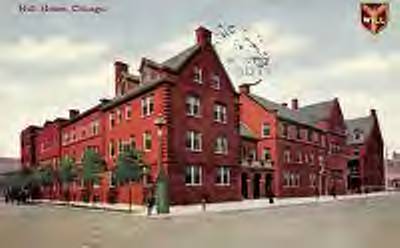
The Eight Year Study came out of a National Capitalism Crisis and a democratic tradition of struggle for both change and the freedom to change. It closely resembled exactly where we stand today and that struggle has a very long history. If we stood on the steps of the original Jane Addams Hull House on Halsted Street in Chicago, we could see the ghostly outline of the Hart, Schaffner Marx building. Knowing the history of labor activism in this country, we would be reminded of the battles that went on in the early years of the garment industry, in Chicago, New York and elsewhere.

These were battles to achieve adequate wages and decent working conditions. Since we didn’t exactly welcome the humanity of immigrant labor, we at least allowed them in and then colonized their work ethic, knowing it made Team USA that much stronger economically.
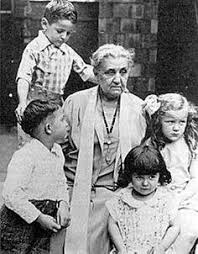
As a pioneer in the American settlement house movement, Jane Addams found herself living and working in neighborhoods that were isolated, ethnic enclaves. Lithuanians claimed one section of Halsted, Greeks another, Italians yet another. These were people insisting upon remaining distinct and separate in terms of a positive cultural identity, yet needing at the same time to work together on the common problems of housing, work, health and education. Hull House provided that place for collaborating.
One testimony of Hull House’s ability to value the differences while using them to build a common ground, are the maps drawn by community people that today are displayed in the front hallway of Hull House Museum. Immigrants went out and canvassed the neighborhoods to discover who lived there. Their findings were then translated into beautiful, color-coded maps. Go stand in front of these maps because they are absolutely riveting!
Today we can only imagine how such a project was organized. From all the ethnic enclaves came people speaking no common language, yet finding the words, the time and the energy to compile a record of who they were and where they lived.
It was a collective effort issuing from a common place. There was desperate need in those turn-of-century times for such places and so, when Graham Taylor, his wife and children, and a cluster of graduate students from the University of Chicago decided to establish a settlement house, they called it Chicago Commons.
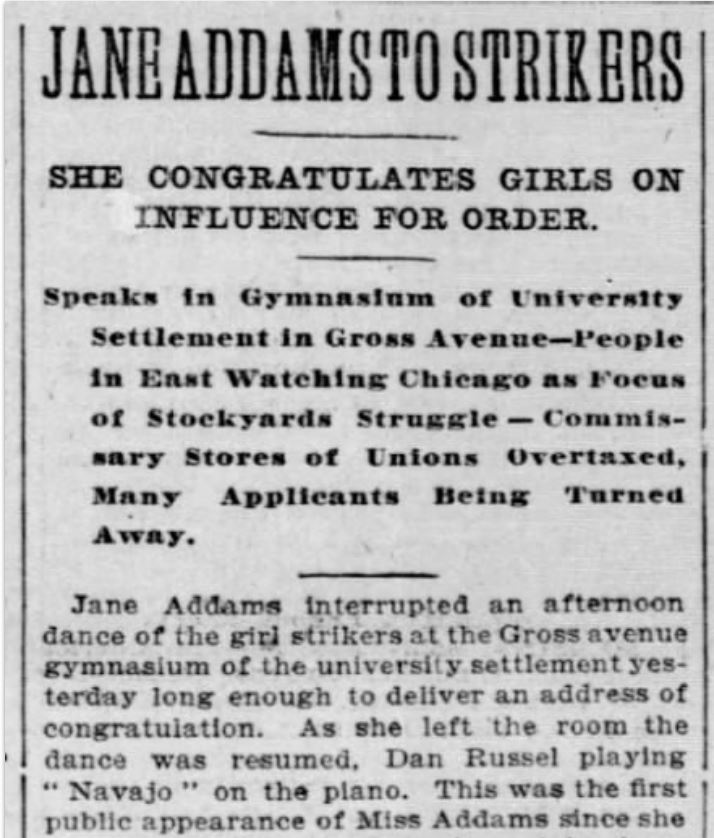
What happened at Hull House and at the Chicago Commons was also what happened at settlement houses in Boston, Baltimore, Des Moines, Jersey City and Fort Worth. The conversation centered around human problems and the social value of a democracy that MUST shape solutions to those problems. A kaleidoscopic range of individuals came together to exchange ideas, voice needs and coordinate action. To make the exchange as extensive and inclusive as possible was a challenge. Hull House met that challenge by numbering among its friends such people as John Dewey, Florence Kelley, W.E. B. DuBois, as well as Russian tailors, Italian factory workers and Bohemian seamstresses. Wish we all could have been there!
If we stretch to identify a similar institution dedicated to many of the same ideals and values, only one comes to mind – Public Schools. It therefore comes as no surprise that during the last decades of the 19th Century and early decades of the 20th, as settlement houses cropped up in urban settings across the USA, we see as well the stirrings that were to lead to the formation of the Progressive Education Association and finally, to the Eight Year Study organized under its auspices.
As the settlement house workers had an expansive notion of what education could do and be, so did the pioneers of progressive education. Both were concerned with blunting the raw edges of industrial civilization and with reinvigorating human community. Both were discovering the forms of human association that could nurture individuality. They were concerned with demonstrating the necessity and efficacy of freedom as a wellspring of personal and social growth.
Just as the settlement house workers had to deal with the destructive human consequences of harsh and mindless factory labor, so the progressive educators were moved to eliminate the factory as a model for organizing the work of classrooms.
The growth of the progressive education movement really began in the years following the end of WWI.
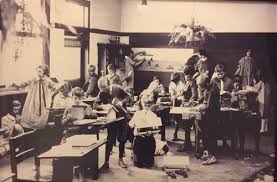
In 1919 a group of educators founded the Progressive Education Association. In the same year, Carleton Washburne became superintendent of schools in Winnetka, Illinois. This was a post he held for 25 years. Under his leadership came The Winnetka Plan, which enabled children to learn at their own pace.
It eliminated failure based on age-linked standards and placed strong emphasis on group activities that strengthened the school and its community.
In this same period, Harold Rugg, Director of Research at the Lincoln School in New York City and professor at Columbia University’s Teachers College, developed his Social Science Course – six volumes complete with workbooks and teacher editions. The Winnetka schools were among the first to pilot the Rugg series. In his texts, Rugg asked students to think together about issues like the invasion of Native American lands by Europeans, the engineered dependence of Puerto Rico, and the contradiction of slavery as an institution in a “free” society. Not surprisingly, the series became notably controversial and was even burned in some American towns.

The explosion of experimental activities in American schools during these early years of the 20th Century is impossible to summarize in a few sentences. Perhaps the best way to capture some of the animating ideas of the progressive impulse is to cite the basic principles adopted by the Progressive Education Association at the moment of its birth in 1919.
1. Children should have the freedom to develop naturally.
2. A child’s interests should be the basic motive for all her school work.
3. Teacher should function as guide and not a task master.
4. Record-keeping empowers sympathetic and scientific study of a child’s development.
5. Schools pay equal & active attention to ALL facets of children’s development.
6. The school and the home MUST be active partners in meeting children’s needs.
The Eight Year Study began as a conversation at the 1930 P.E.A.Conference. Two years of further conversation followed. Initially there were no foundation dollars involved and people participated at their own expense. Beginning in 1932, support from Carnegie and the General Education Board helped underwrite the expenses of what was called the Commission on the Relation of School and College. It was this commission, created by the Progressive Education Association, that designed and directed the Eight Year Study. Its first action was to conduct an assessment of American secondary schools.
The Commission found that students were graduating with no sense of what it meant to be a citizen within a democracy. They found no connection between daily community life and the fundamental human values intended to guide that life. Student concerns and school curricula were miles apart. Does this sound familiar?
Where to begin? What to change? How best to change it?
As a starting point, the Commission focused on the freedom to change. That may have been one of the wisest decisions it ever made. It was clear to all members that high schools were most powerfully and extensively regulated by college admission criteria. So the Commission sought and won the agreement by some 300 colleges and universities to waive their existing criteria for graduates of the experimenting group.
It was also clear that experimentation could not and should not be the exclusive right of a few private and privileged schools. There had to be diversity of character, economic class and geography. And so the roster of participating schools included Altoona Senior High in Altoona, PA; Roosevelt High School in Des Moines, IA; Tulsa Senior and Junior High Schools in Tulsa, OK; Eagle Rock High School in Los Angeles, CA; and Shaker Heights High School located outside of Cleveland, Ohio. On the private side were such schools as Francis Parker in Chicago, North Shore Country Day in the northern Chicago suburbs; several Quaker schools; Lab Schools like those at the University of Chicago, Ohio State and Wisconsin; and other private institutions like Milton Academy, Baldwin School and the Winsor School.
(1939) https://youtu.be/b7lHva6HAlc

In the fall of 1933, all schools began building new curricula. The process was intriguing and it varied dramatically from school to school. Institutions affiliated with the P.E.A. had been dealing explicitly with the following questions for years. What are democratic values? How do we recognize them in practice? How do we test such values publicly? How do we teach the ability to think deeply and critically about the social issues and problems of the day? How do we construct a descriptive yet dynamic portrait of a student’s personality and character? How do we use that portrait to understand a student’s needs, actions and feelings? Imagine considering all of this instead of simply casting about for worksheets that make life easier on Google Classroom, Google Hangouts and Zoom.
As bold and fascinating as it all was, it also was a very human venture just as it would be today. Complexity and the frustration of false starts were all part of what was to be explored. The English Department at Altoona High replaced required reading lists and book reports with literary parties, discussions, impersonations and book clubs. It also designated one day a week as a free reading day. No one ended up reading as few as the 14 books formerly required. Student were reading because they wanted to read. A junior high school math teacher in Altoona organized an insurance company run by students. It insured students against loss and damage to school books. The need to invest premiums led to a study of banking and investment because the students had money to invest, not because it was demanded by a grade level course of study.
Radnor High School in Pennsylvania addressed program needs for non-college bound students. They developed a senior curriculum known as the Cooperative Course. These were tryout training opportunities for students in one or more vocational fields. Each tryout lasted two weeks. Local business people agreed to provide some form of introductory experience or training in a given field. These field experiences amounted to something between a part-time job and an apprenticeship, where instruction, supervision, evaluation and reports to schools became routine practice.
In 1936 a group of nine men began working across the country as Eight Year Study consultants. They served only at the pleasure and invitation of individual schools. The consultant did not stick around for long and it was not his role to dictate or impose. Instead, he assisted by NOT having an ax to grind or a stake in the local broils.

Like a Pony Express rider, each carried news of work in other schools. They visited classrooms, gave demonstration lessons, and served as a mobile clearinghouse for research, ideas and materials. Often they helped school people move their own mountains just by taking the time to leave a well-placed word of encouragement and understanding. In short, they were summoned to assist teachers in discovering their own ability to act and change. It all was very similar to the Advisory System we saw in the British Infant School Classroom movement of the 1960’s.
There is renewal of interest in the Eight Year Study today because we still have educators who believe that American Schools must once again become innovative and lively places. The essential value then and now is democracy. This feature, more than any other, sets the Study apart from contemporary school reform movements propelled largely by technology-driven appeals for increased test scores, accountability and productivity, aimed at debilitating poor and working class communities.
We get our possibilities from one another. Simple and inescapable.
This means we must have well-funded, public and not privatized or stratified charter schools bent on profiting from us, separating us and making us STRANGERS to one another. Public schools nurture a democratic citizenry wherever kids from diverse backgrounds arrive and are permitted to learn with and from each other.
Coronavirus has now introduced public schools to the nightmare of impoverished and infected households where faculty, children and youth are suspended in a national nightmare of inaction. A mockery of education is being transmitted to millions of laptops, tablets and cellphones. Students cannot meet one another in person due to regional infection levels and they cannot meet one another intellectually, creatively or academically because state-controlled bureaucracies refuse to take principled action in their behalf.
Good teachers are once again stepping up and speaking out in protest over the dis-information, disorder and dis-ease now being inflicted on public schools 2020-2021. It is guided from above, by a technocratic mindset adept at junk bond trading, corporate takeovers, bank bailouts and economic dominance. But for those of us committed to the democratic tradition, the Eight Year Study is both our ancestor and ally. It reminds us that the idea and broad practice of democracy comes with a price.

If we want it to remain or become the centerpiece for citizens, teachers and students, then we’re going to have to fight for it. Eternal Vigilance is an action and not a slogan. Those who have most recently been taking their feet to the streets are absolutely leading the way.




 kathyirwin1