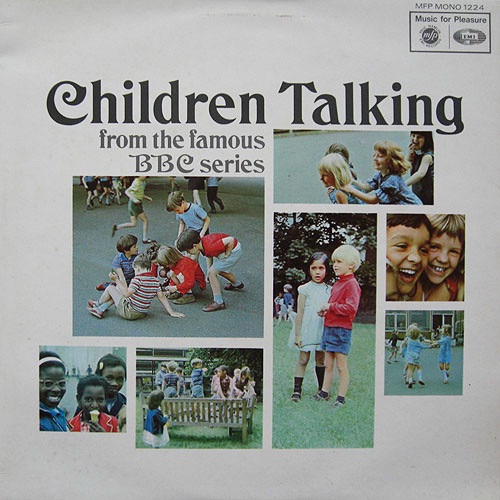
The journalist Harold Williamson was known on radio and television as the man who talked to children.
Yet he would be better described as the man who listened to children.
He believed that bringing up a child was the most skilled job anyone could have, and to see him take a child’s hand in the school playground was like a benediction, only noisier and merrier.
Originally created by journalist Harold Williamson, the series is a delightful time capsule where kids share their raw, unvarnished perspectives on everyday topics like religion, space, wealth, and marriage.
The show famously features children from across the UK—from East End day trips to Calais to Lancashire classrooms—answering profound and everyday questions with charmingly honest logic.
You can also watch curated compilations and episodes on BBC iPlayer or explore classic clips and full segments on the official BBC Archive YouTube Playlist.
1982 a Professor of Science and Mathematics Elementary Education at Hofstra University observed a kindergarten class engaged in learning.
Their only instruction was to build a tall tower out of clay. But once the towers reached a certain height, they fell. After some thought, one girl began to build her tower in a spiral. It grew taller. She tunneled a cave in the base to source more clay. Other children collaborated and followed her instruction. Soon many had tall, structurally sound towers.
The girl knew nothing about stress, compression and tension,” Goldberg stated in his summary article Learning How to Learn.
“If this young student’s mind is repeatedly stimulated in this way, she will be able to learn whatever she chooses. We will have taught her how to learn.”
The girl learned a process of discipline through thinking, experimenting, questioning, making mistakes and trying again.
Children who are challenged to think, to speak, listen with others and to try multiple solutions are disciplined. Goldberg concluded that “actively striving to find answers through interesting and significant investigations can engaged the WHOLE child, not just a part of his or her mind.”
Erin Grant
The article “Learning How To Learn” by Professor Lazer Goldberg is published in the journal Science and Children.
Journal:Science and Children, Volume 19, Number 7.
Publication Date: 1982 (Pages 10–11).
Digital Access: You can locate and read the full text digitally through the JSTOR Database.
This is how Lazer Goldberg talked with children. About chemistry. In his 1962 book The QUESTIONS and ANSWER Book of CHEMISTRY.
Perhaps you think of chemistry in connection with beautiful colors, bad smells or surprising explosions. Maybe you have seen some chemical demonstrations by your teacher at school. Whatever caused you to become interested in discovering more about chemistry, you will find that doing experiments yourself is much more exciting than watching other people do them.
There is much more to chemistry than making beautiful or surprising colors, bad smells and loud bangs. Chemistry helps us to understand what materials are made of and how and why these materials can change. Chemistry teaches us how to break up substances and put them together in new ways.
When you do the experiments in this book, you will not be playing at chemistry. You will be a REAL chemist. You will heat, cool, dissolve and measure substances. You will mix, grind, wet and dry them. You will put together some substances to make new ones. You will test them. When you are really interested in chemistry you want to know why things happen as they do. This book includes explanations to help you understand your experiments.
And here is a note from your friendly A.I. The 1960s was the golden age of chemistry sets, dominated by brands like A.C. Gilbert and Chemcraft by Porter. These thrilling kits contained real labware, alcohol burners, and chemicals that inspired a generation but are largely unavailable today due to strict modern toy safety regulations.
The Golden Era of Home Science During the mid-century science boom, these kits were marketed as the ultimate career-building toys. Kids were treated like real-world scientists, mixing powders to create reactions, and learning to handle laboratory glassware at their own kitchen tables.
What Was Inside a 1960’s Kit? A typical Deluxe or Senior Lab kit from the 1960s came packed in a folding metal or wooden carrying case, featuring: Glassware & Labware: Test tubes, beakers, pipettes, test-tube racks, glass tubing, and filter paper. Chemicals: A dozen or more powdery elements and liquids in glass or metal bottles (e.g., potassium permanganate, copper sulfate, and calcium hypochlorite). The “Lab” Feel: An alcohol lamp (burner) to apply heat to reactions. Manuals & Comics: Comprehensive “Fun with Chemistry” manuals, mini-comic books, and atomic-themed literature to spark the imagination.
The Danger and the Discontinuation While historically legendary, 1960s chemistry kits could be surprisingly hazardous. They routinely included instructions and raw materials for making smoke bombs, toxic chlorine gas, and even fires. As a result of increased government regulations and safety concerns in the 1970s and 1980s, the era of the “wild” chemistry set ended.
Effective Science Learning has its roots in curiosity and care-giving. We give a care. The natural world is important to us. We are part of it!
Living creatures are ideal for study in every classroom. What are their names both common & scientific? How do we construct the right habitat? What do they eat? How much do they weigh? Is there a timed biological cycle or response to environmental cues like temperature, light, food or seasonal change? Do they have skin or fur or feathers?
In 1965 Boston’s Ealing Company filmed a series of ecological wildlife films ranging from Alligators to Water Fleas & from Beavers to Moose. The human actors in these films were elementary school children.
They were shown caring for & investigating living creatures. The investigations were behavioral. Meaning not psychological or invasive hurtful. They also were open-ended films showing only the beginning of an investigation since students were being prepared to continue the investigation on their own in their classroom over time.
Each film also included a non-science area. In the Guinea Pig film the children graphed the growth of their animal. In the Frog film children choreographed a dance that mimicked frog movement. In the Snail film the children made wax-resist paintings of snail trails. In the Iguana film they made sculptures of a very well- behaved iguana.
An excellent animal behavior science inquiry book is Anna Botsford Comstock’s The Handbook of Nature Study.
It is now in its 24th edition and is Kindle available on Amazon. Cornell University’s Anna Botsford Comstock wrote and illustrated several books including Ways of the Six-Footed, How to Keep Bees, The Handbook of Nature Study, The Pet Book & Trees at Leisure.
A raft of thin-film silicon bubbles deployed from Earth into outer space and stretching to the size of Brazil could potentially block the Sun’s solar radiation from further warming Earth. Possibly helping to not only stave off climate change but potentially reverse it.
This new “space bubbles” plan offered by scientists at the Massachusetts Institute of Technology rifts off a concept first offered by astronomer Roger Angel.
The multidisciplinary team of architects, civil and mechanical engineers, physicists and material scientists have worked on the technical and social aspects of what the group calls a “planetary-scale project” in an effort to find a non-Earth-bound solution to climate change.
Each individual bubble is a tiny object in a vast ocean. But together they influence the upper ocean. Bubbles generate sound when they form and scatter sound. Bubbles change the colour and transparency of the ocean because they scatter light. Bubbles act as small vehicles transporting gases through the ocean surface in both directions. When bubbles rise to the surface and burst, they spit tiny liquid droplets up into the sky. Those aerosol particles formed in this way scatter light & haze. And they may drift high enough to act as cloud condensation nuclei.
In 1827 the Bolognese painter Pelagio Palagi painted “Newton Discovers the Refraction of Light.” Newton is depicted as being struck by the discovery of the phenomenon of light refraction as he observes a child blowing bubbles. In the painting the bubble becomes the world. A globe is placed on the right-hand side of Newton. The bubble occupies a similar position with the child.