Herbert Spencer Zim was a teacher and author in the field of science. Sonia Bleeker (Zim) did the same for children but focusing on Anthropology. Sonia and Herbert travelled all over Africa, Europe and North and South America.
Always taking notes and doing research for her many books about Native Americans, Pre-Columbian cultures and various African tribes.
1954, 1955, 1958, 1960, 1963, 1969 Editions
The Quiz-Me Books were a series for youth featuring impressive Museum illustrations, a clearly written text and a concluding list of questions which sent the reader back into the text for further investigation.
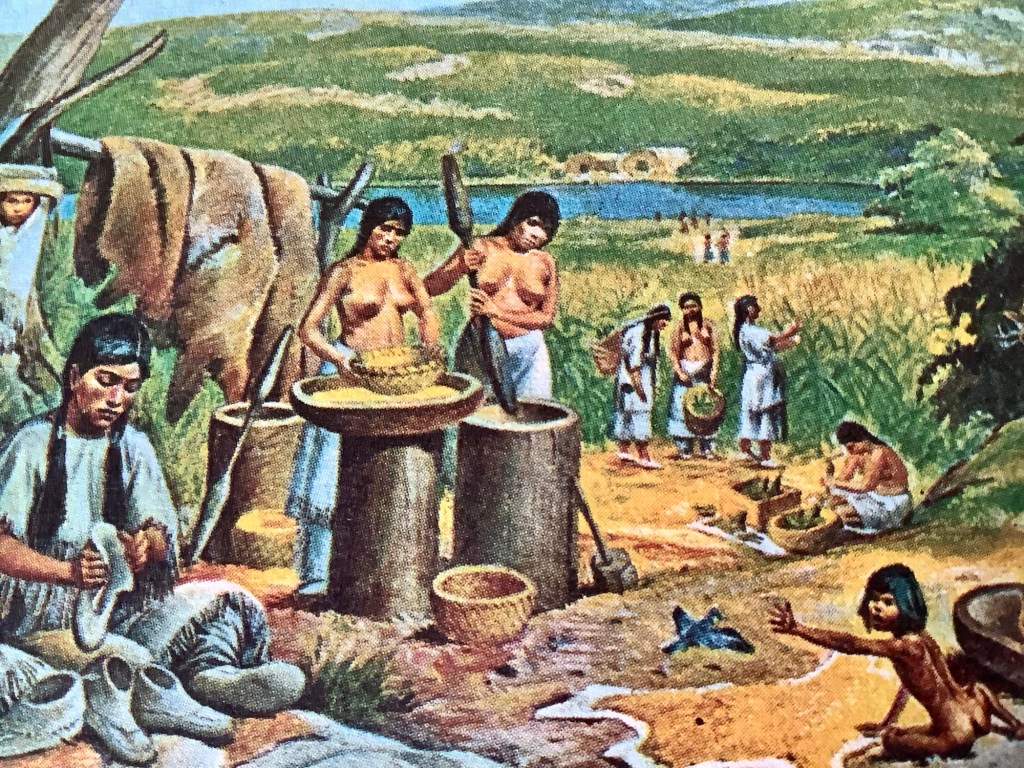
Sonia’s INDIANS book is arranged by topics that are close and familiar to the lived experience of a contemporary child. Good starting points for beginning inquiry into complex cultures. Homes, Family Life, Hunting & Farming, Clothing & Ornaments, Languages, Tools & Weapons, Transportation & Trading, Religion & Ceremonies, Games, Feasts & Dancing.
Pre-Colonization Family Life is described as happy with parents who took good care of their children. A child naming ceremony was considered important to the clan because it bestowed upon each child a name that possessed special powers. A baby was given a nickname so that the secret name never got used up thereby wearing out its power. This is exactly the sort of anthropological detail that adds an element of magic and mystery which appeals to imaginations young & old.
A Busy Iroquois Household
Women are shown with breasts. And Sonia writes that all mothers nursed their children and the baby was always with its mother. Fathers took charge of sons when boys were old enough to learn planting, harvesting, hunting, weaving or chipping, flaking and fashioning arrows, wampum or turquoise ornaments.
Turquoise
Every Indian man, woman and child was once upon a time surrounded by relatives. Elders transmitted the ceremonies & rituals of the tribe as well as the sacred pathways to adulthood. Presented is the portrait of a stable and thriving society. BEFORE Invasion, Enslavement, Disease, Genocide, Occupation, Forced Relocation, Destruction of Food Sources, Demoralization, Despair. The Deliberate Devastation of a Way of Life.
Even a speed read of Sonia Bleeker’s Quiz-Me paperback would leave one asking very different kinds of end-of-chapter study questions. How can the annihilation of 80 Million Indigenous people be imagined? What facts should be included that might help us calculate such horror? Which anthropologists in 2025 are researching and writing for school age children seeking facts about cultures & customs recovered and revitalized precisely because of the richness they contribute to the vitality of democracy?
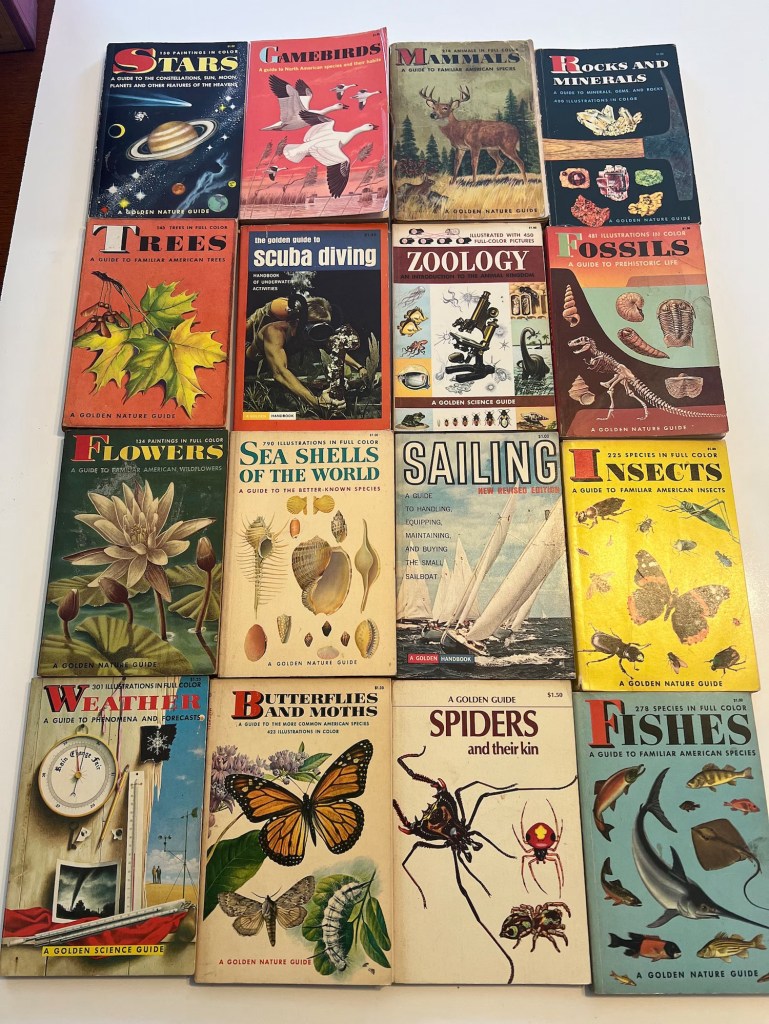
Herbert Spencer Zim. Ever meet him? You probably have if you’ve picked up one of the wonderful Golden Nature Series Paperbacks.
Herbert was the author or co-author of more than 100 books and countless articles. And he was known to generations of children as the man who explained everything from the workings of parachutes to which birds could be found in Central Park in the fall.
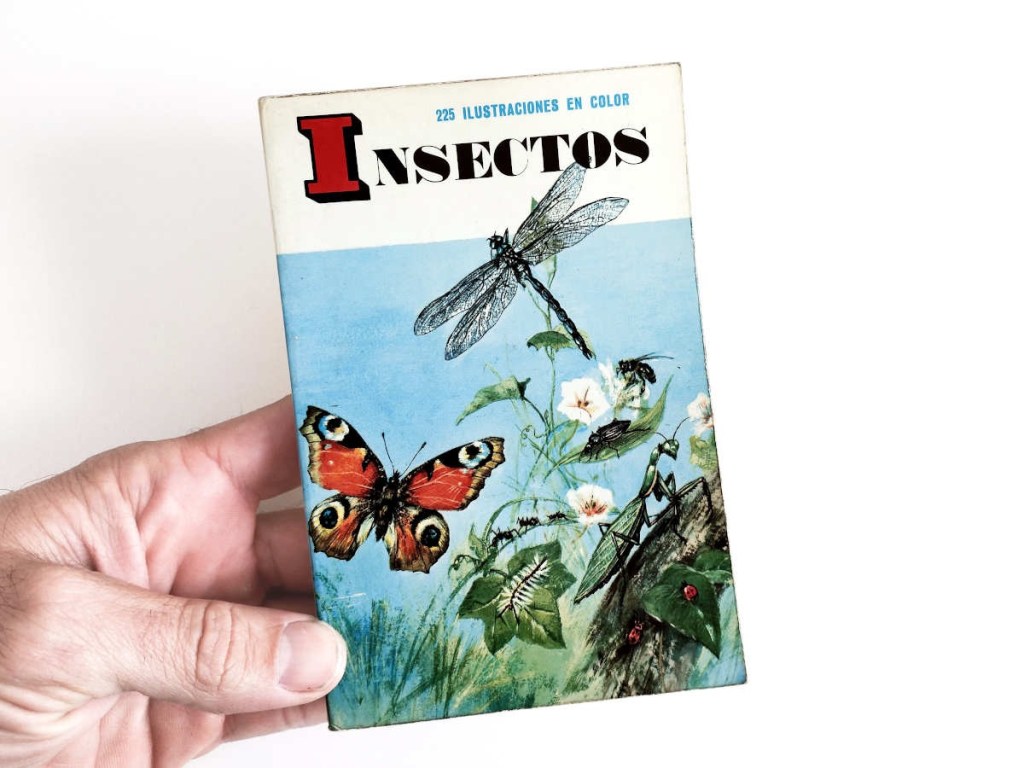
The Golden Nature series, including “Birds,” “Insects,” “Fishes” and “Trees,” exemplified his style. Concise, engaging and comprehensible to children without being simplistic. The 1966 book “Birds of North America,” which he co-wrote, is still regarded as a staple of the field.
Starting with “Mice, Men and Elephants” in 1942, he set about writing children’s science books at a dizzying pace. His early works, like “Air Navigation,” “Parachutes” and “Submarines,” often dealt with mechanical science.
In 1947 he became the editor of Simon & Schuster’s Golden Nature Guides, and he began writing some of the books in 1949. He also wrote articles for magazines, particularly those devoted to education. He edited a children’s encyclopedia, “Our Wonderful World,” in the mid-1950’s.
Golden Nature Guides
Like Herbert Zim, the Los Alamos scientists of The Manhattan Project, also believed that children in a Democracy need to understand the science of their world. In the 1960’s they began their own versions of elementary school science investigations designed precisely for classrooms. Hands-on places where curiosity and inquiry were encouraged. Not annihilated in the interest of profit-driven, corporate testing tyrants.
There was a philosophy.
The important thing in any learning is to be able to use it, to go beyond it, in the direction of still further learning and activity. When we look at our classrooms, what do we hope to find? We hope to find children working with confidence and intensity on problems of their own choosing. The primary objective at any given moment is that the children be involved with the caring about it enough to make their own effort to come to know it better.
Children work best when trying to find answers to problems that they themselves have chosen to investigate. These problems are best drawn from their own environment and tackled largely by practical investigations. Teachers should be responsible for thinking out and putting into practice the work of their own classes. In order to do so they should be able to find help where they need it.
A group of Los Alamos physicists were passionately fond of the elegance of physical phenomena such as pendulums, balances and inclined planes. They called themselves The Playground Physics Group. And started by looking at swings, seesaws and slides.
They had a good beginning set of materials and ques- tions for balances. And they were gathering courage to try them out with children. A footlong ruler was balanced on a rounded piece of wood, and a few metal washers were placed along it, preserving its balance. Someone held on to the stick and moved one of the washers. Next someone had to move another of the washers so that move compensated theirs and the ruler would remain balanced when they let go.
How about trying to make as many layers as one could have colored liquids? And then finding particles (rice, plastic bits, wood chips) that floated between the layers. Moving from beakers to closed pill bottles, focusing on the motions the liquids made as they were turned over or stirred up. A favorite was corn oil sit- ting on red-dyed glycerine with a few radish seeds at the interface.
Manhattan Project David Hawkins wrote:
“Along with the growth of intuition and understanding goes a necessary component which can only be called aesthetic. An enjoyment, a sheer enjoyment of the phenomena themselves. Make up a few color tubes and play with them. What is this good for? Is it going to lead to an understanding of density or surface tension? Probably not. Well then, what is it good for?
I think part of the answer is that the tubes are just good and one doesn’t have to ask immediately what they are good for, or indeed, whether they are good for anything at all. Try them out and just see if they generate further ideas for exploring the curious behaviours of different sorts of liquids.
Or think about butterflies. Here is much richer scientific fare. But would it have the richness if it were not for the marvellous colors and shapes and movements of these little animals? Every part of science has its own characteristic phenomena and gives rise to characteristic — one is tempted to say — art forms. Contrast the style of the caterpillars and butterflies with the elegant motion of a ten-foot pendulum.”
How About Ants! A little creature often ignored.
What is it? What does it do? How does it move? What does it eat? How does it catch its food? How does it live in these little sand pits? How does it eat? How does it make these little pits? Can it make pits in gravel? In flour? In sugar? In ashes? Does it prefer sand to gravel? How does it throw things out of its pit? How big a thing can it throw out of its pit? Can it see where it goes?
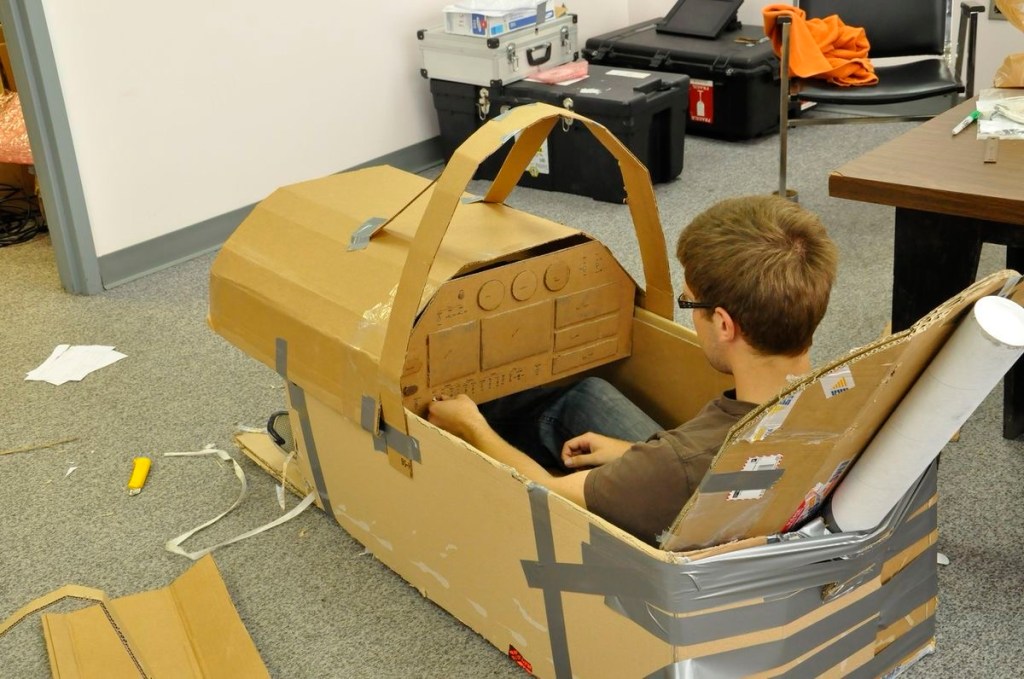
The likes of Philip Morrison, Frank Oppenheimer, Victor Weiskopf, Stan Ulam and Jerrold Zacharias were deeply interested in the activity of ants, bubbles, worms, pendulums, cardboard constructions and butterflies. They joined Herbert Zim and thousands of school teachers on the hunt for children who came absolutely alive in the presence of a natural/physical world that they were invited to encounter and explore.
Jerrold Zacharias knew that reductionist data-points & testing tyranny were the ultimate enemy of thinking people in every democracy. He wrote:
“I feel emotionally toward the corporate testing industry as I would toward any other Merchant of Death. I feel that way because of what they do to the kids. I’m not saying they murder every child. Only 20% of them. Testing has distorted their ambitions. Distorted their careers. It’s not something that should be put in the hands of commercial enterprises.
I have often referred to tests as the Gestapo of Education Systems. Uniformity and Rigidity require Enforcement. So I have chosen a most denigrating title for the enforcement agency. Its hallmark is arbitrariness, secrecy, intolerance and cruelty.”




 kathyirwin1