Archives for category: Free Public Schools

Blow bubbles so they float down into the clear container. The bubbles will descend and then hover on the denser layer of carbon dioxide gas accumulating above the dry ice.

After a few minutes, notice that the bubbles begin to expand and sink. Notice how some of the bubbles freeze on the dry ice.

Frank Oppenheimer was an experimental physicist. And one of the crucial instruments of his era for visualizing the paths of subatomic particles was the BUBBLE CHAMBER.

Invented by Nobel Laureate Physicist Donald Glaser. This device used a superheated transparent liquid like liquid hydrogen that would boil and form a trail of tiny bubbles along the path of a charged particle passing through it.

These tracks could then be photographed and analyzed to understand the fundamental building blocks of matter.

https://www.newyorker.com/magazine/1960/11/19/bubbles-2

Adults need their own time to experiment with materials like Bubbles.
By experimenting you might realize that what you are really doing is exploring concepts like surface tension, balance, aerodynamics and velocity. Nature is a significant source of materials. And nature is the language of Mathematics.

David Hawkins Mathematician & Philosopher Of Science

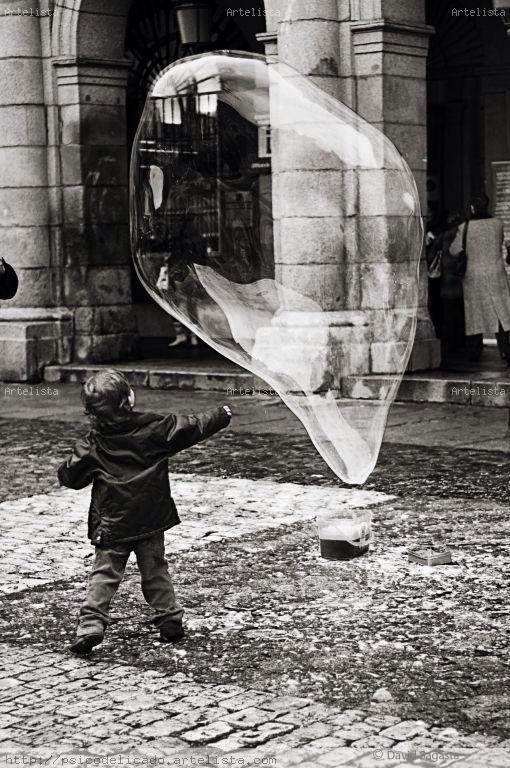
Bubble Play studies forces like thickness, wind speed, flow, elasticity, film drainage & bursting dynamics.

A single, simple bubble is actually a complex scientific model.

Soap Bubble Investigation looks into physics, chemistry and fluid dynamics.

Change a bubble solution recipe by adding glycerin, sugar or alternating blowing techniques.

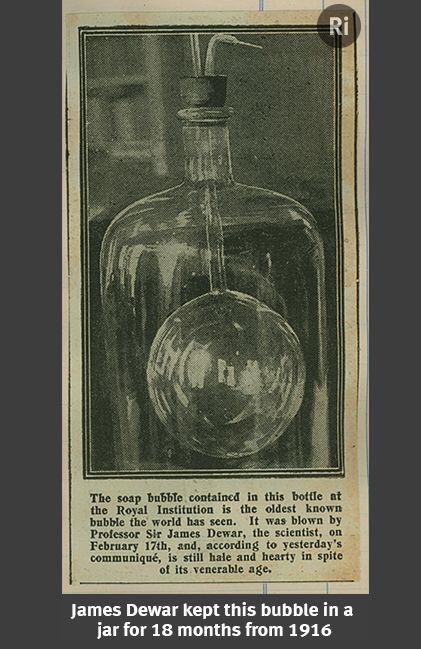
How long does the bubble last?

What happens to its size?

How does the revised bubble behave?

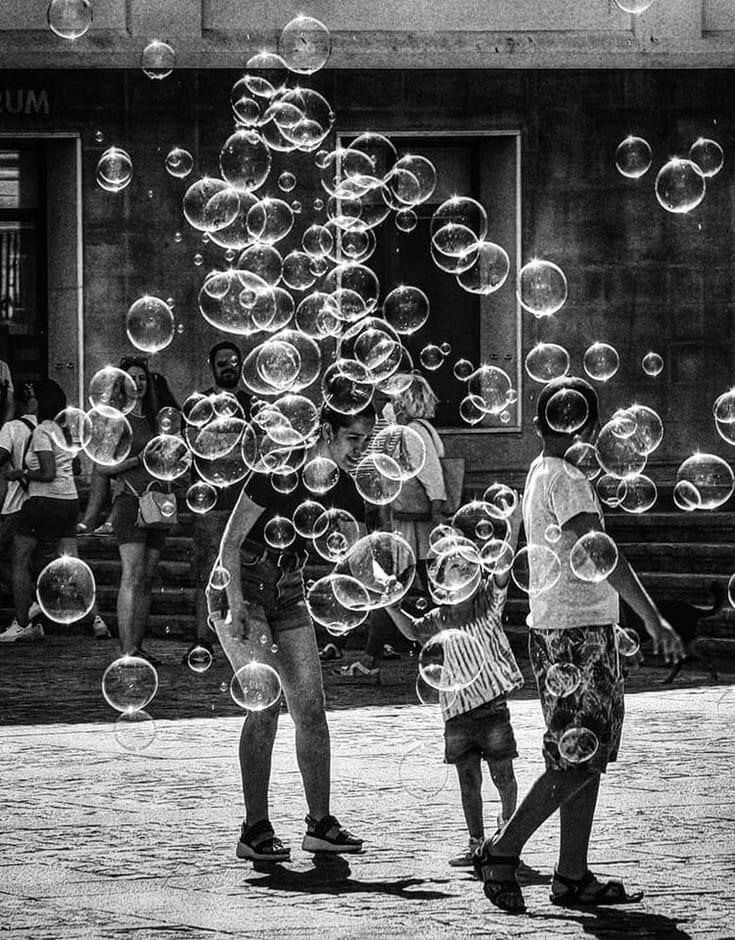
Bubbles Vibrate

And Their Motion Is Subject To Control.

Scientists discovered that shaking bubbles vertically can make them move horizontally. We can transform vibrations into directed motion. As in opening doors for controlling micro-robots or particles in fluids.

Creating a spherical film of soapy water.

And trapping air.

With colors arising from light reflecting off its inner and outer surfaces. 

A free-floating bubble is a sphere because it’s the most area-efficient shape for enclosing a volume. The arc is just a segment of this sphere.