It is possible to make a pretty good weighing device, in the form of a balance, using a couple of soda straws, a few pins and a moderate amount of ingenuity. Jerold Zacharais liked to say that he could weigh a fly’s wing with such a device, and he probably could have.
Any student who struggled to achieve it would almost certainly emerge with a new respect for the meaning of measurement. The appreciation was the real point of PSSC. Not accuracy for its own sake but rather for the understanding that it made possible. It was designed to provide a sense of the playfulness that often characterizes good science and with the delight of discovery.
There were many other features of PSSC that were attractive to scientists. Improvising inexpensive and ingenious equipment such as the soda straw microbalance or thinking through how to make atoms and molecules real and believable, filming complicated but interesting physical phenomena. All of it had enormous appeal.
The film called A Million To One deserves description because it conveys so well the light-hearted spirit that came to exist in the studio. The PSSC equipment group had improved upon an invention called a dry-ice puck. It was a simple disk that could float almost without friction on a thin layer of gaseous carbon dioxide. Using the same principle as the British Hovercraft which rides on a cushion of air. The carbon dioxide is obtained from an evaporating piece of dry ice carried in a container attached to the puck. The whole structure weighs perhaps 2 kilograms. But friction is reduced to such a low level that the puck can be set skimming across a smooth surface by a very small force.
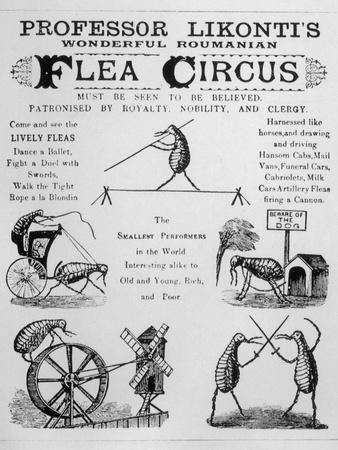
“Zach was so impressed by these dry-ice pucks that he kept saying, ‘I’d like to see a cockroach pulling one of these pucks.’ Unknown to him, the film crew went down to New York City and found a flea circus on 42nd Street run by a Professor So-and-So. They made a deal with this guy and they made a three or four minute film strip. The guy actually harnessed a flea to one of these five pound pucks. And they had the movie where the flea actually pulls this damn thing. It was really marvelous.”
A Different Sort Of Time: The Life Of Jerrold R. Zacharias/Scientist, Engineer, Educator. By Jack S. Goldstein/MIT 1992.
I somehow managed to cram myself into the narrow space at the back of an African 5th Grade classroom. Scientists, educators and administrators had traveled from America, England and other parts of Africa. We had come to Kano to attend a remarkable conference on African Science Education organized by Jerrold Zacharias.
Zacharias had arranged for us to come to this school to witness a local African teacher, who after only 2 weeks of training, was going to teach science not by TELLING students about it but by putting the simple materials of science, in this case flashlight bulbs & batteries, into their hands. Letting the children manipulate them and make their own experiments. Boxes of scraps containing bits of wire, paper, string, wood, paper clips and rubber bands. The teacher simply asking, “Can you light the bulb?’
Self-consciousness and uncertainty evaporated quickly. One by one, flashlight bulbs lit up. First in one part of the room and then another. Illuminating briefly each time the intense absorption and delight in the children’s faces. Each of us watching had felt that same sense of wondering delight as young children in rare and lucky moments of discovery. We were thrilled to recognize it again now. The teacher moved quietly among the groups of students. Offering encouragement here. Asking provocative questions there. “Can you make the bulb give a brighter light? Can you light 2 bulbs? Will string work in place of the wire?”
60 of us had gathered in Kano. Many of us professional physicists, chemists, biologists and physicians. We had little prior experience with children’s science or with Africa. Yet here we were. Filled with a contagious enthusiasm. Ready to learn. Ready to go forward. I did not understand by what magic Zacharias had persuaded hard-headed scientists that we might be useful in such an adventure. But he did and we were willing.
The Cold War influenced Zacharias strongly. Reinforcing his unembarrassed love for Democracy, Decency and Fair Play. He felt a scientist’s abhorrence of dogmatism. Especially the forms of it that he encountered. McCarthism, Communism, Know-Nothingism and Radicalism of any sort. He came to believe that Education was the most effective way to address the ills of the world. “In order to save Democracy, we’ve got to educate the people who vote. There’s no question in my mind about that.”
A Different Sort of Time/The Life of Jerrold R. Zacharias/Scientist, Engineer, Educator. By Jack S. Goldstein/MIT 1992
Robert Wolfe Columbus Dispatch Owner-Publisher took his family vacations in the American West. Inspired by those adventures, in 1927 he purchased 20 acres of land in Pickerington, Ohio. And created what became a 64 acre wooded retreat which was named WIGWAM.
It was furnished with Native American decor.
Tableware and carpeting displayed the theme. The Wigwam dishes and glasses carried the 1930s picture of Two Gun White Calf. One of three Native American Indians who posed for the likeness of the Indian on the Buffalo Nickel. A portrait that was taken by Walter Nice, a photographer for the Columbus Dispatch newspaper in 1909. Mr. Wolfe engaged a Dispatch cartoonist to paint stagecoaches, trains, airplanes, covered wagons, teepees, cowboy cabins and other scenes from the American West. The Native American decor continued outside with an authentic totem pole.
In 1910 Columbus city officials hired Edgar S. Martin to advise them on how to begin a Parks and Recreation Program. Martin’s efforts met stiff resistance from conservative taxpayers but the idea prevailed. And Martin convinced Columbus City Council to appropriate $15,000 for an initial investment. State bonds were then issued for purchase of playground and recreation equipment.
Edgar Martin was an avid supporter of the emerging Boy Scout movement. He established the first Boy Scout organization in Franklin County Ohio and was responsible for introducing naturalist outdoorsman woodcraft expert Ernest Thompson Seton to Columbus.
Seton first lectured in 1927 at the Franklin County Memorial Hall where he immediately helped raise $1,300 to launch the first Scout troop. He found enthusiastic supporters in the League of Ohio Sportsmen. Seton gave talks at their statewide assemblies about nature conservation and appreciation, woodcraft, Scouting, hiking, natural health, Native American Indian lore, dances, prayers, games, clothing, fun, wisdom and reverence for the great outdoors.
The Wolfe Family purchased the Columbus Dispatch newspaper in 1905. Their newspaper immediately began to cover Seton’s Columbus community activation faithfully. The League Of Ohio Sportsmen began bringing Boy Scouts to Seton lectures. On 12/18/1927 Columbus Ohio Scouts met Seton at the Deshler Wallick Hotel. Seton talked to the men and boys about the traditions of Woodcraft Indian Council Fires, the outdoors and its enjoyments. Seton’s Woodcraft League of America was explicitly presented as a recreational opportunity for girls and boys.
By May 1928 the Mayor of Columbus had authorized the head of City Recreation to collaborate with Seton on plans for building an Indian Woodcraft Village on city property, located on the banks of the Scioto River. The site of an original Wyandot Native encampment.
Seton’s 1928 drawings included an Indian Village Day Camp headquarters building. A smokehouse kitchen. Wigwams, teepees, longhouses.There was a trash burning area. A sweat lodge and a Sun Bath. Bunkhouses. And an outdoor education space for plays, dances, games, storytelling, camp crafts, wood crafts and community gatherings. Periodically, Seton offered training workshops at the Columbus Board of Education for any adults interested in becoming teachers of woodcraft and leaders in woodcraft nature study.
Seton-designed Indian Village Day Camp was formally dedicated in May of 1928. It was laid out next to the Fishinger Road Bridge. The camp was grouped around a longhouse which functioned as the Dining Hall and Council Chamber. There were 5 teepees and 2 wooden lodges providing sleeping quarters. City Recreation operated the camp and when in summer season, there were nightly Council Fire Gatherings for 50 inner city children.
July 4, 1932 the Dispatch newspaper ran a story on Indian Village Camp plans for the national holiday. Boys week and girls week alternated. On 7/4/1932 city neighbors were invited to visit. At 2:30 PM a play was performed. Sports, field games, bead-making and swimming were on the schedule. Supper was served at 5:30 PM. And at 6:30 PM The Scioto River Boat Club staged canoe races! At 7:15 PM Mayor Worley gave an address. Joined by campers who put on a Seton-inspired Council Ring Ceremony.
At 8 PM The Improved Order of Red Men, under the leadership of one Harry Lehman, concluded the evening program.
Harry Lehman’s IORM was founded in 1834. It was a national fraternity with members wearing Native costume and nomenclature. Their rituals were historically focused on preservation. One member said, “The value of the ceremonies of our Order is their historical accuracy. They seek not merely to imitate, but to preserve. When the time comes that the Indian race is extinct, our Order will occupy a place original and unique. And becoming at once, the interpreter of Indian customs and the repository of Indian traditions.” Columbus Red Men Lodge #128 continues to operate in Columbus 2023. Located at 2634 N High St, Columbus, OH, United States, 43202.
In July of 1949 the Columbus Dispatch newspaper again referenced Seton’s tradition. A Summer Reading List of Nature Books included a review of Ellsworth Jaeger’s COUNCIL FIRES. The Buffalo Museum of Science Curator was a member of Seton’s Woodcraft League. And he produced a detailed account of campfires, fire-lighting, peace pipe ceremonies, games, songs, stories, Indian dances, Indian equipment and how to make all of it using whatever was locally available.
Dr Samuel S Palmer Pastor of Broad Street Presbyterian Church initially helped Seton start the Indian Village Day Camp. Mrs Maude Fowler Wolfe was the wife of Dispatch publisher, banker & civic leader Edgar Wolfe. She served on the Board of Broad Street Presbyterian.
The chosen location was rich in Wyandot Indian lore and Seton hand-carved a large Totem for the encampment. Mr. A W “Bugs” Raymond was the Parks and Recreation Director. In the beginning, he operated the camp on weekends only. But after that, the Federally-funded WPA arrived and helped construct the cook shack and other new buildings.
By 1947 the Dispatch newspaper boasted of the camp’s 11 cabins each housing 8 campers + counselors. Swimming pool, shuffleboard court, a dining hall and well-equipped kitchen. A recreation hall for rainy day programming and a crafts department. In 1947 camp sessions were 2 weeks long. Offering hiking, boating, swimming, fishing, camp fires, Indian lore activities, games, dramatics and gymnastics. Tuition was $18 a session with additional costs covered by philanthropic donations.
Ernest Thompson Seton’s Camp-craft work lives on. Today you can visit Seton Woodcrafters in the modern Czech Republic!
The Czech Woodcraft League 2023 continues to bring people to nature and teach them how to stay there and get by with just a minimum of the items they have brought from their home in the city. It is believed that this is the way how to bring back to life the things which have been forgotten, both spiritual and practical. When camping in nature people can understand again where they have come from and revive their bonds with nature.
We practice so-called primitive camping, imitating techniques of the Native Americans, primeval people, indigenous people and others who were masters of woodcraft.
Our aim is not to imitate indigenous people in all details or promote the escape from civilization. We just want to help people find the roots of their humanity.We believe that lifelong education is the core principle of building true humanity. That is why we put stress on learning by doing within the Deed system. Using E T Seton’s Birch Bark Roll of Woodcraft, which was modernized and updated after the Czech Woodcraft League Revival in 1990.
A Woodcraft International Meeting is being planned for sometime in 2023-2024. Uncertain political landscapes will determine if the gathering is ZOOM or Hybrid/meaning a bit of both.
OBJECTIVES: Create an international coalition of Woodcraft practitioners. Develop new friendships and connections across the world. Share best practices across the world. Identify ways to improve traditional WC/Woodcraft activities intended to reduce/eliminate Amerindian cultural appropriation and increase each organization’s focus on their own culture.
Activism means one is ACTIVE. Nimble, energetic, progressing, vital, vigorous, getting things done.
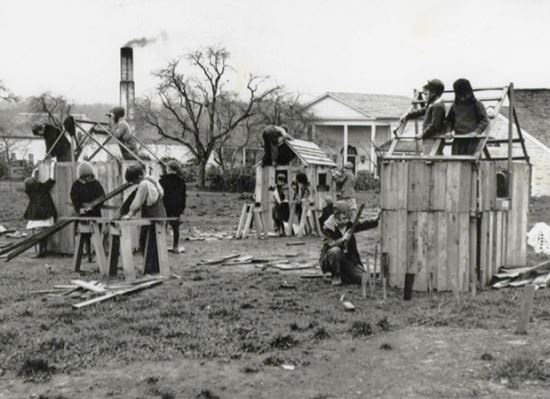
When Elsie Ripley Clapp answered John Dewey’s request and took on the Directorship of the New Deal Arthurdale Community School, she went in prepared to quite literally get her hands dirty.
There was no school building. For that matter, there was no Arthurdale Community. It was a buckwheat farm owned by Mr. Arthur which was about to be plowed under and converted into a FDR Hot Political Potato.
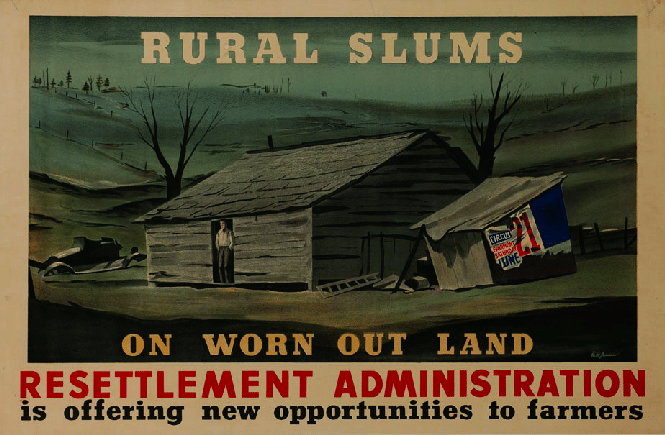
Critics came climbing out of the woodwork complaining that the Resettlement Administration was nothing more than thinly-disguised socialism/communism/collectivism.
A Living New Deal
The Arthurdale school and its Homestead were what we might call today a Pop-Up. An instant Emergency Relief effort on a massive scale. “Destitute or low-income families from rural and urban areas would be transferred to newly-built towns. Their employment would address the converging catastrophes of soil erosion, stream pollution, seacoast erosion, reforestation, forestation, and flooding. The government would make loans to finance the purchase of farm lands. Also money for the equipment needed by farmers, farm tenants, croppers or farm laborers.” Rexford Tugwell, the Undersecretary of Agriculture, was put in charge.
Clapp did not waste time Political Protest Posting on Blogs, Instagram, Linkedin, Facebook, Twitter, TikTok, WordPress or YouTube. She had a big job to do. Arthurdale Activism was not mistaken for a string of words shouting back at hostile, bitter, virulent, venomous, fat cat critics. Her about-to-be Public School had to get up and running. The proof of the pudding really is in the eating. She knew it would start out messy, muddy, maddening and miraculous. It was all of that and more.
Coalminers’ Kids Building A New Life For Themselves In Arturdale
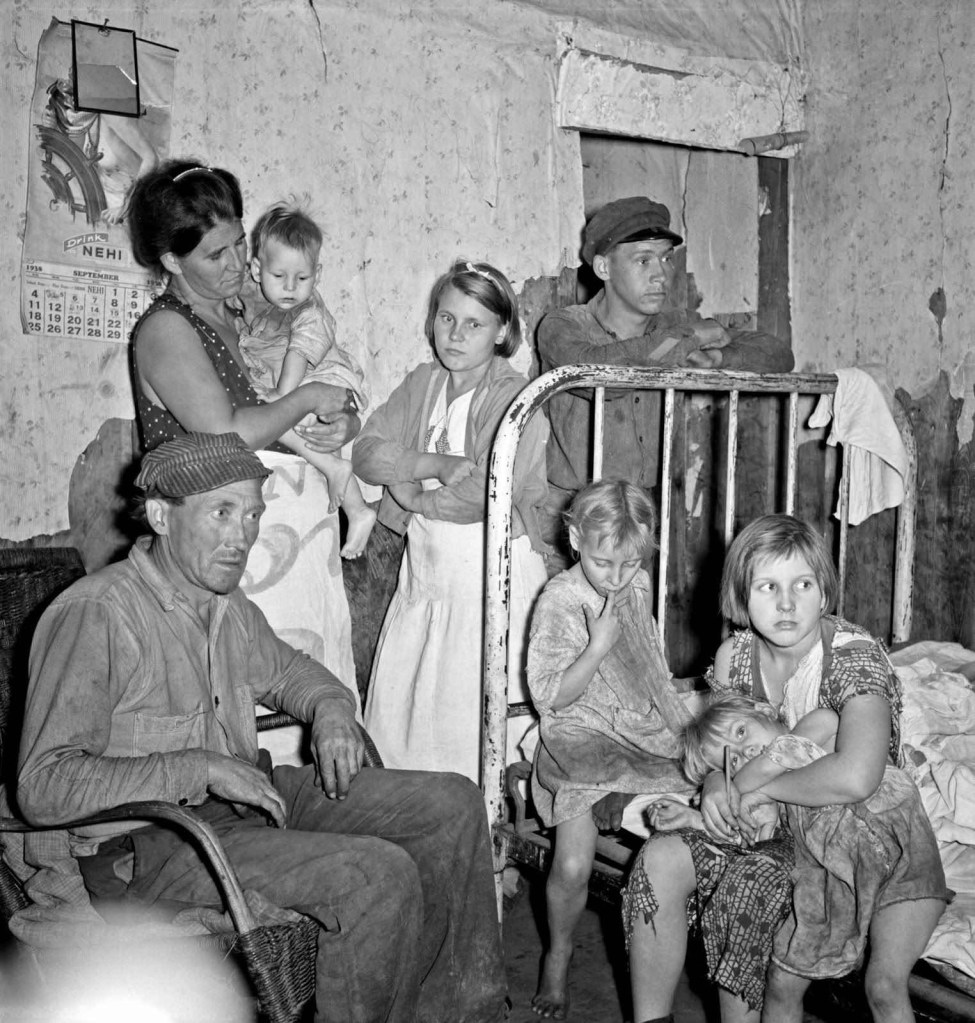
The coal miner families of Scott’s Run West Virginia knew they were abandoned. No work, no money, no food, no running water, no heat, no medical care, no schooling. No way out. No surprise. The boom and bust cycles of industrial mining had remained the same since before the Civil War. Once the unrestrained greedy barons departed, the human misery set in. There was no rescue in sight.
1938 Pursglove Mine Scott’s Run
But the families of Uvalde Robb Elementary did not know they were abandoned. Yes, they had inherited a legacy from decades of bigotry against indigenous Hispanics. But all around them was the ever-present, well-armed law enforcement. Border Patrol Costumed As Hunter-Killers roaming the barrio-colonia arresting Migration People and shoving them into the rapacious For Profit Detention Centers located nearby.
It turned out that the only policing competence required in Uvalde was the ability to slide up next to Gov Abbott’s right-wing wallet and purchase as much Military Industrial Complex Tough Guy paraphernalia as the city/county budget would allow. It was simply an investment in Make Believe. A stage play, a manipulation, an illusion and a calculated strategy operating to preserve and perpetuate raw, political power. No protection. No rescue in sight.
“On the bloody morning after, many Tin Soldiers rode away.” One Tin Soldier Song Lyric/Brian Potter / Dennis Earle Lambert 1969
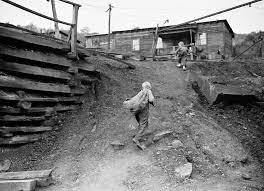
Scott’s Run was a long valley of coal seams crowded with camp after camp. As Elsie Ripley Clapp/ERC drove along she saw abandoned tipples, burning slag heaps, no trees, no gardens. Steep hillsides made barren, coal black, ugly and dangerous with flimsy, dilapidated shacks.
Some were crowded along a highway but others much worse, were perched high on hillsides. unkempt, leaning, empty storefronts, broken glass fronts, rickety porches. There were worn-out advertisements, dirty under-stocked stores, trash for as far as the eye could see.
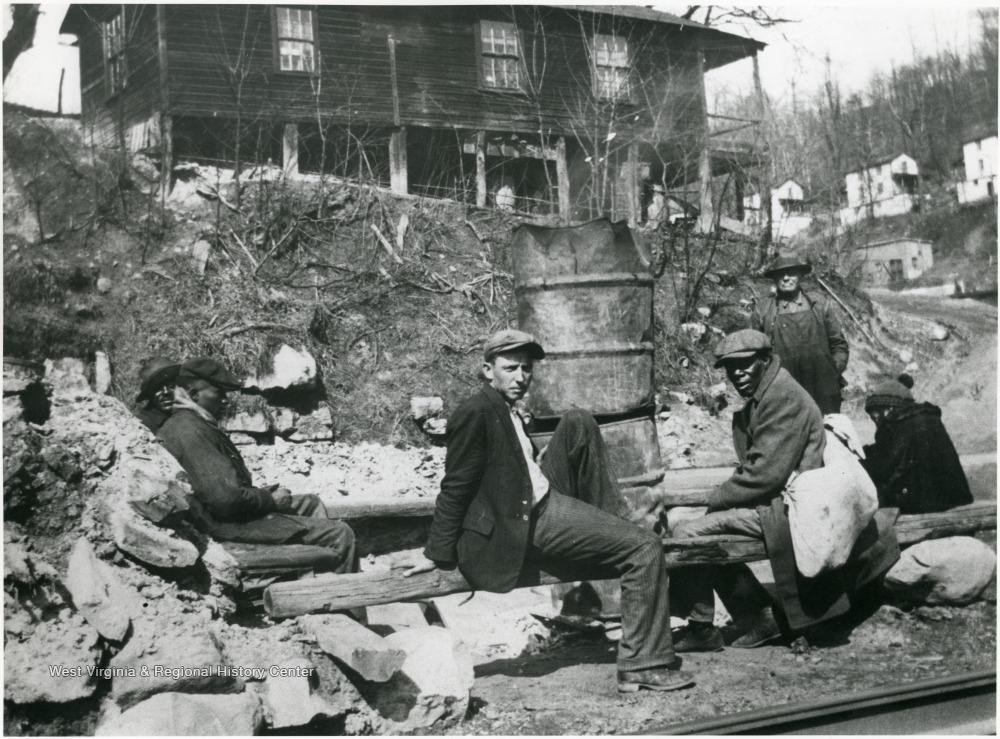
And then there were the men. Listless, smutty-faced with their raggedy sweet-faced children and maimed curs. One single camp was built on a cinder heap. Not a tree. Families living in long shacks. Just one room or two with a foul privy behind. What passed for a school was 40 children in a room, sitting in desks from 9-4. All of it resting precariously on a hillside high above.
There was Nadia Danilevsky talking to men who were laying pipes for what might become a public water system. At long last, they were going to have running water and certainly that would help. But no amount of water could wash away the utter, awful ugliness, nor the listless/hopeless atmosphere.
This place was a rotting shell leftover from the Boom Days. It was the epitome of abyss and abandon. And one could not help feeling outraged that human beings would be obliged to exist under such miserable circumstances. This description became the POINT of the Community School.
Scavenging For Coal To Warm & Cook
The Community School that E.R. Clapp went on to create was what we might today call an activist school. It was a public school that took action.
Robb Elementary in Uvalde, Texas is of a similar mind and history. Clapp and her cohorts had the tragic residue of industrial/police state greed and corruption to deal with. Uvalde was afflicted with the pernicious legacy of colonizing capitalism fueled and excused by rampant racism. Robb sits in the middle of its Hispanic community.
Its families have fought tooth and nail since the late 1960’s for a safe facility, books, buses, nutritious school meals, Spanish-speaking faculty. The basics.
Genoveva Morales, mother of 11, filed the first lawsuit in 1970 that resulted in a Court integration order. That came after a massive, multiple school walkout. Six weeks of protests, pickets, armed Texas Rangers patrolling the Hispanic streets of Uvalde, Huey helicopters flying overhead and taking recon photos of marchers. The Community School responded with packed, contentious school board meetings, a Freedom School, a Free Lunch program, a newsletter, a Teatro/Theater company and much more.
In 1980 The US Department of Justice sued Uvalde schools. It charged them with racial discrimination and the persistence of policies that diluted the voting power of neighborhood Hispanics. At-large school board elections had been engineered to ensure that no Mexican Americans won.
Marching For Their Lives
If you want to STOP a Community School dead in its tracks, make sure no one from the community can get elected to governance, oversight, policy/finance/curriculum decisions or review of the parent complaints that pile up after decades of abuse and neglect and exploitation.
When Elsie Ripley Clapp first toured the ruined coal camps of Scotts Run WV, they were dangerous places. Children were dying and so were the adults. No, not dangerous like the gun massacre in Uvalde TX.
In Great Depression Era Scotts Run, no one had thousands of dollars to spend on expensive weapons of war + ammo. Even bullets for a squirrel gun were at a premium. So was the squirrel meat. Everyone was starving and perishing the old fashioned way. TB, scurvy, rickets, pellagra, typhoid, pneumonia, hunger. Slow and lethal.
Elsie Clapp came from the social and economic class of people responsible for this carnage. What she saw came as no surprise.
She knew that the Gilded Age had made their millions off the backs of laboring miners and then simply walked away once the plunder was complete. She knew this but she did not accept it. It was wrong and it could be remediated. And so she set about creating a Community School.
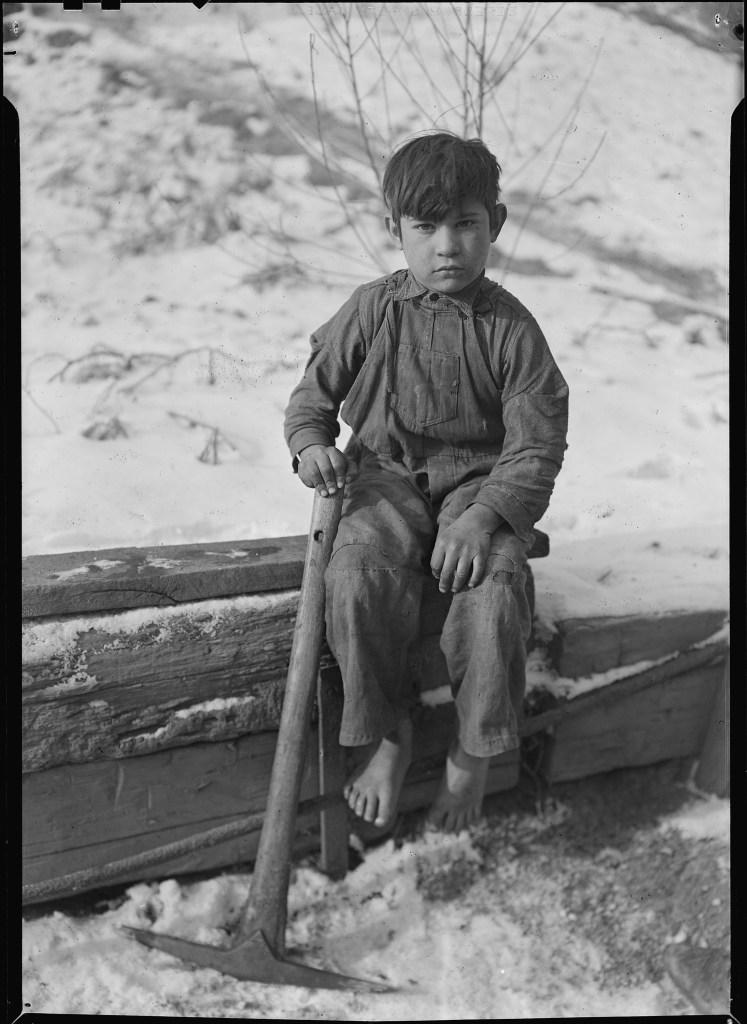
Snow Ice Shoeless Search For A Chunk Of Coal
There could be no Community School without living-breathing inhabitants. And conditions had been allowed to get so bad that the area most closely resembled a war zone full of 4,000-5,000 skeletal humans on their very last leg. President Hoover had been sitting on a fund of money originally designated for feeding Belgian and French children post WWI.
At long last the war relief money was ultimately handed over to Alice Davis, Nadia Danilevsky and Clarence Pickett with the American Friends Service Committee. Food rations and fuel for warmth and cooking was the first order of business. Clapp described seeing scrawny children playing in stinky, sulphur-ridden puddles by the side of the road. She walked into a long, corrugated-iron shed with #7 painted on the roof. Down the length of the shed were small cots. A wood stove was at one end and a jerry-rigged shower at the other. A young woman with an ancient air about her, bent over and toothless, introduced Elsie to the improvised, rudimentary Nursery School. “We bathes ‘em. We feeds ‘em and we sleeps ‘em,” she proudly announced. This constituted a beginning at the center of oblivion.
ERC went to the West Virginia coalfields AFTER the Energy Oligarchs had taken the money and RUN back to Wall Street. She set about creating a John Dewey-inspired Community School in the midst of rich, reactionary USA.
It looked a lot like 2022. Today in Texas, the Fat Cats are hunting down Beto O’Rourke and his campaign for Governor. BETO should see them for who they really are. Sheldon Whitehouse would like to assist with the eye opening.
Canyon Lake area is very BIG money. Lake houses, boats, expensive recreational toys, gas-guzzling SUV’s, multiple Airstreams. Weekend homes, retreats, resorts. Local, everyday middle class people there are treated to a Canyon Lake version of the oligarch playground. BETO can’t secure a campaign event venue in Comal County because the money men don’t want him or his democracy.
Breaker Boys
This is calculated, strategized, High Finance Fascism. Leading the assault on BETO are the very same people who stand to benefit from ending the filibuster for Gorsuch. FBI tanking of the Kavanaugh investigation. Inserting unqualified Amy Barrett onto The Bench. Spending $580M to OWN SCOTUS. Establishing the Federalist Society as the MAGA headhunter for SCOTUS nominees. Paying $17M to purchase the services of Right Wing Nominees. Destroying a Woman’s Right To Choose. Polluting everything/everywhere for FREE. Loading up the USA with Dark Money. Abolishing Voting Rights. Deregulating The World. Demolishing public Schools. And so much more. It is an old script and one that Clapp confronted once she arrived in Arthurdale, riding on FDR-New Deal coattails.
Sheldon Whitehouse posted his 2022 list and is warning BETO and the rest of America To Buckle Up ‘Cause It’s Gonna Be A Bumpy Ride. There is no time for “engaging” with these rapacious monsters. They are Hungry Ghosts with insatiable appetites. BETO has great energy and instincts but he needs to WISE UP & toughen up. Take it from Elsie Clapp. Everything we hold dear in our Democracy is at stake.
When Elsie Ripley Clapp agreed to leave her cushy community school post in Jefferson County Kentucky and move her work to FDR’s Arthurdale, West Virginia New Deal project, this is what she faced.
The NMU, National Miners Union, was organizing all over the place. Our federal government honchos feared a “commie insurrection”, and with good reason given the living conditions, so the combined idea of a subsistence homestead and a community school was born.
Elsie Ripley Clapp left the luxury of the Ballard Memorial School and parachuted directly into an economic cauldron of greed, labor abuse, human neglect and starvation.
There are many good things to report about the community school developed in Kentucky but later for that. Because nothing had prepared Clapp and her team for what they encountered in WVA. The mine owners disappeared once there was no profit to be made. And left behind miner families in shacks with no food, fuel, light, water or hope. The NMU was the only organization with a presence and a platform.
Everyone could have decided just to allow the NMU’s analysis to dominate. Theirs was not so much an act of ideology or propaganda, since blind, deaf and dumb Helen Keller could have readily figured out that industrial capitalism was not working for anyone in Scotts Run.
The miners required no outside agitators because they were experiencing firsthand what transpires once the Fat Cats have cashed out. Those miners’ fury contained a transformative energy that was alternately retaliatory and relentless.
Elsie Clapp was about to try creating a community school where there was no community. Maybe where no semblance of community was even possible. Everyone she encountered was on their last leg and fresh out of patriotism.
Scotts Run conditions are nothing new to educators who work in Title I schools. Settlements of people where gainful employment is cancelled, exported or excluded by a prevailing paradigm of greed, do tend to go hungry, get violent, self medicate and establish bootleg economies. It is NOT Mr. Roger’s neighborhood. But it is a politically criminal construct, devoid of conscious and with a bad habit of blaming the victim. The boom had gone bust.
The about-to-be community school was only one of many ”stars” in a constellation of federal agencies suddenly vying for funding, visibility, control and prominence. It was Presidential Power Politics from the git-go and it was a huge pain in the neck for Elsie Ripley Clapp.
The Great Depression was no Shock Doctrine Surprise Disaster. In fact Herbert Hoover and his cohorts had been watching it unfold like a slow moving slasher movie. Spectators and Instigators combined, the federal government did nothing until revolution was at their doorstep. It was then that Hoover put Texan Jesse Jones and the RFC into action. A White House Conference on Child Welfare was convened and suddenly, the leftover WWI funds from feeding starving Belgian and French children were unearthed. That money was given to Clarence Pickett and the American Friends Service Committee of Philadelphia. Humanitarian relief became a good idea and an immediate, hot political potato.
Elsie Clapp rode into the devastated West Virginia mining camps on the coattails of Eleanor Roosevelt and the newly-elected FDR. Not the most auspicious moon under which to launch a subsistence homestead or a community school. Chaos reigned supreme and so did critics. By the summer of 1933 the NRA/National Recovery Act was funded and looking to relocate displaced and disgusted populations cramped and crowded into industrial centers where righteous insurrection was a certainty. John Dewey could not protect her here. Nor could waxing philosophically on the virtues of democracy. If they/she wanted a community school, it would require a seasoned educator with the skill set of a roadhouse bouncer.
A “pioneer” in the Community School Movement was 1929 Elsie Ripley Clapp when she took John Dewey’s thinking on democracy into The Ballard Memorial School in Jefferson County Kentucky. Not all that far from Mayfield, Kentucky where today the public high school is still standing after last night’s devastating series of tornadoes.
Mayfield High School has been turned into a shelter. People are taking refuge there. They are being fed, treated for injuries, fed nourishing, cafeteria meals. Clothing is provided, WiFi, relocation services, even transportation to another safe destination.
It does not take much to imagine this as an example of a community school IN ACTION. No one chose this weather catastrophe but it serves to remind us of what resources community schools can coordinate when administering to The Moment.
Elsie Clapp later ran a community school in FDR’s industrially ravaged Arthurdale, West Virginia. Starving families were literally selling body & soul just to stay alive when this Great Depression era school sprang up from a buckwheat farm and began demonstrating how public schools can enter a crisis and become the HUB and the ❤️ HEART of people-directed restoration and recovery.
Charter schools are in no position to do any of this work. It is not in their “DNA”. But it is the genetic makeup of community schools and there is plenty of crisis at hand. The Pandemic is the monster opportunity but so is the climate crisis headed our way.
Elsie Ripley Clapp learned how to enter, enjoy and energize the very humane energy stream of people-powered problem-solving. Community schools walk right into the middle of the fray, facing it head-on because they are the practical embodiment of We The People.








 kathyirwin1