


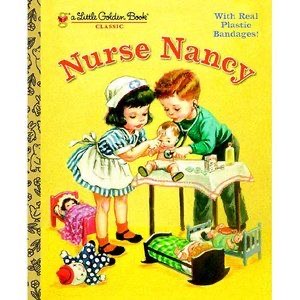


Listen to a ❤️ heart beat, Take a temperature, Measure out pretend liquid meds using a calibrated dropper, Feel for a pulse, Create and use a handmade eye chart, Tap knees for reflexes, Create a patient chart with dates, times, symptoms and cure, Write a prescription, Make a Patient scheduling book, Fill empty containers with food coloring meds and use art supplies to make bottle labels, Learn the names and spellings for common medications like aspirin or eucalyptus. Fill your hours with imaginative medical investigations. Oh, and be sure to draw a detailed x-ray of a human body. Lots of bones to consider.


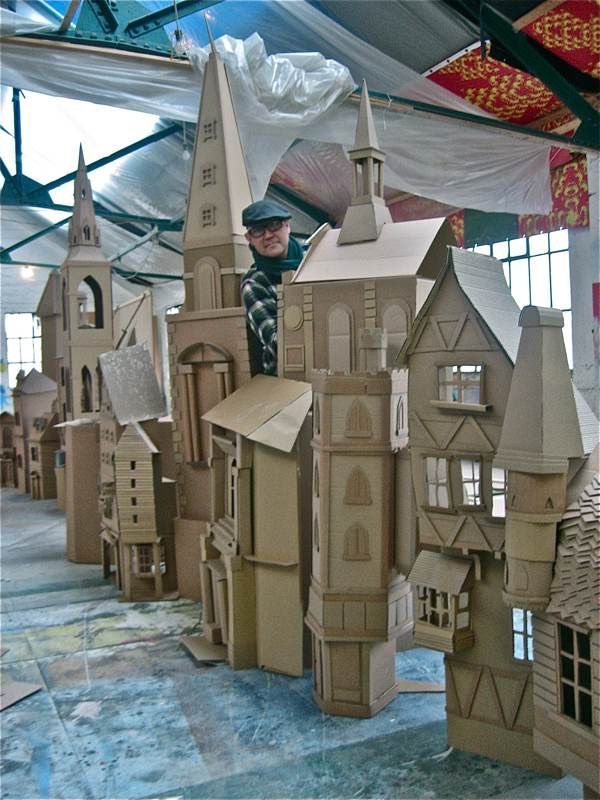
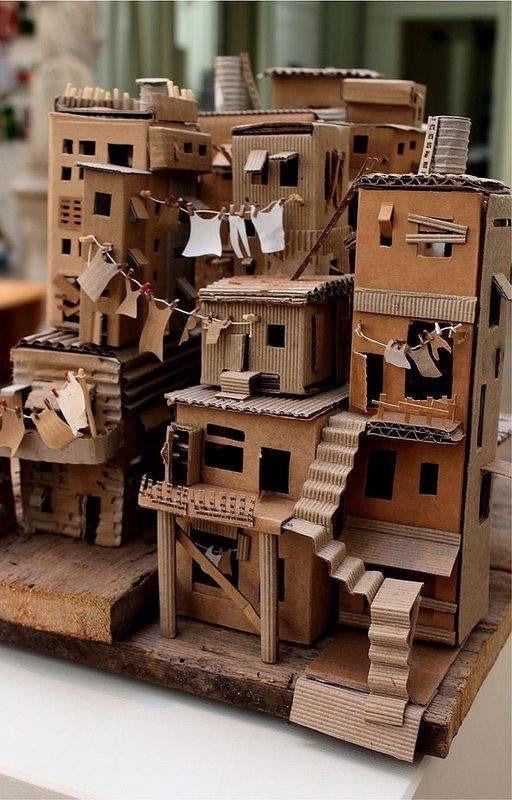
Cardboard Carpentry is easy because cardboard is readily available. The images here are works of art using sturdy cardboard. But any cardboard will do. Cereal boxes, index cards, recycled greeting cards, cracker boxes or packing boxes are all suitable. Tape and glue are necessary. And very young children usually benefit from having someone to partner with.
Pictures can help. Images of huts, cabins, apartments, castles, duplexes, houses, stores, businesses and complexes give children an idea of how structures are assembled, connected, designed, decorated and interrelated.
Collections of miniature people, animals, transports, furniture, plants, grasses, toys, tools, kitchenware or art provide detail for the imagination.


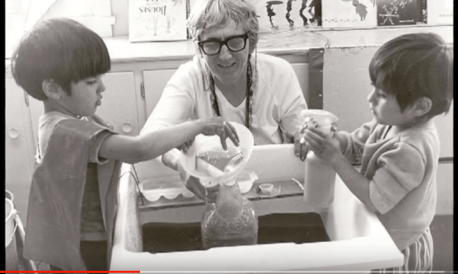
To the Water Table Frances Took: Clean detergent squeeze bottles, old plastic medicine jars, perforated berry baskets, funnels, flexible, plastic tubing of varying length and diameter, plastic medicine droppers, poultry basters, bulb ear syringe/aspirators, corks, plastic measuring cups, plastic water jugs pint, quart, gallon, mini bike pump, battery-operated fan, clear plastic eye dropper, salt shaker, wide variety of sponges.

There is a portraiture involving the child’s style – strengths, weaknesses, skills fears, and the like. I single out one aspect of this complex, the way a child comes to grips with some subject matter, matter originally provided because it matches the general level of interest and ability of a still individually unknown group – building blocks, clay, paint, batteries and bulbs. If this subject matter represents something which the teacher has valued and learned from, and seen others learn from, then the teacher has a background for reading the behavior of that child.
In a film from Cornell University, a series of kindergarteners come spontaneously to a table to play with an equal-arm balance and a large number of washers and other weights. In watching the film, the observer begins to recognize in himself – if he is personally familiar with the large variety of balance situations which are possible here, and with some of the underlying ideas – the ability to read the levels and the specializations of interest represented in these children, no two alike.
What he finds himself doing (but only if he is acquainted with this kind of balance phenomenon and others related to it) is beginning to build what I would call a map of each child’s mind and of the trajectory of his life. It is fragmentary, fallible, but it is subject always to correction. and next the observer thinks to himself, what could I do to steady, extend and deepen this engagement I have glimpsed?
The important thing is that, as in all self-instruction, the participant DOES something.
What It Means To Teach
David Hawkins
OUTLOOK
Mountain View Center For Environmental Education
12: Summer: 1974
Joseph Featherstone’s Schools Where Children Learn highlights the work of Elwyn Richardson in northern New Zealand. Featherstone suggests that In The Early World may be the best book about teaching ever written. Certainly it’s one of the most beautifully designed. Reproductions of children’s art of an astonishing quality fill its pages – wood and linoleum cuts, pottery, and fabrics, as well as writing.
Featherstone reflects that it takes time for the reader to understand that a long account of how the class took up pottery is meant to be emblematic of a whole style of teaching. Clay of various grades lay in deposits near the school, and Richardson and the children tested samples to see which kinds were good to work with. They built a small brick kiln and pottery became the standard activity in the school.
Messing around, the children slowly learned the limits of the material – you couldn’t build wet clay too high or it would collapse.
Pottery grew into writing deeply influenced by the natural world surrounding the school.
The pine tree stands
With cracked sooted arms
With stumped branches
Rotted into the ground
Richardson’s testimony on the work: I saw that I had to teach as much as I could when opportunities arose, and that this was a better kind of teaching than I had known when I was following through topic after topic. If I did not teach at such times, the work became poor and lifeless….The series of developments taught me too, that I must use environment to the full and encourage individual expression rather than class. This meant more individual and small group observation.
Elwyn S. Richardson, In The Early World, Pantheon Books @ 1964.
Yes. These are all school chairs. Or they should be.
Have a look.
No institutional, plastic, mass-produced, poorly-welded rubbish.
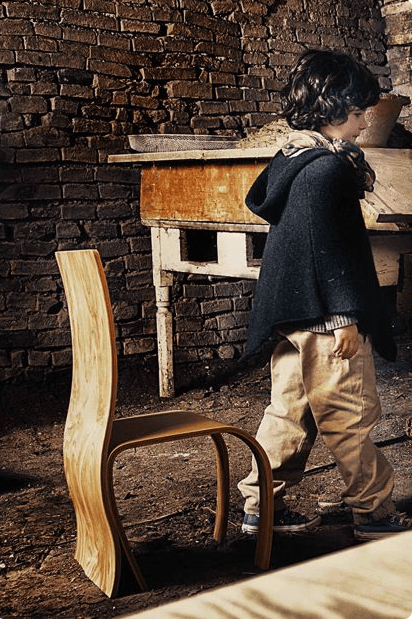
From Italy
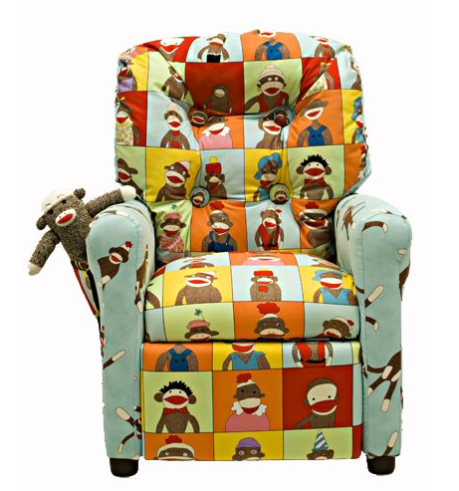
Sock Monkey
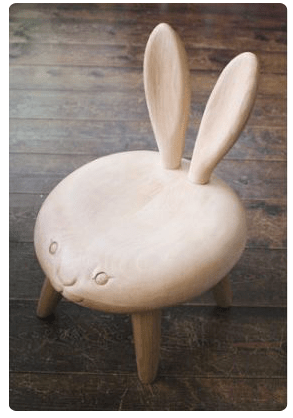
Bunny Chair
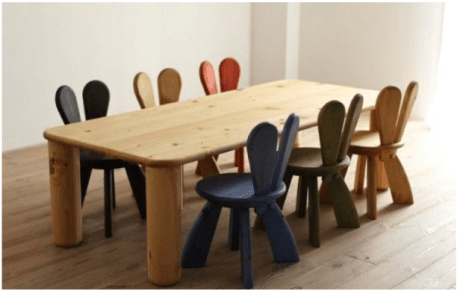
Japanese Company Hiromatsu Children’s Furniture
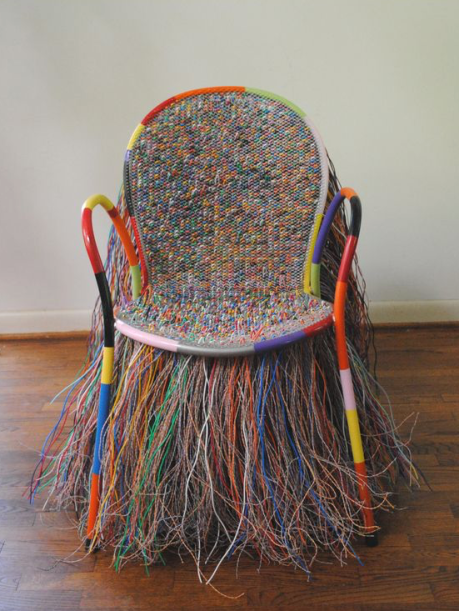
Fiber Art Chair
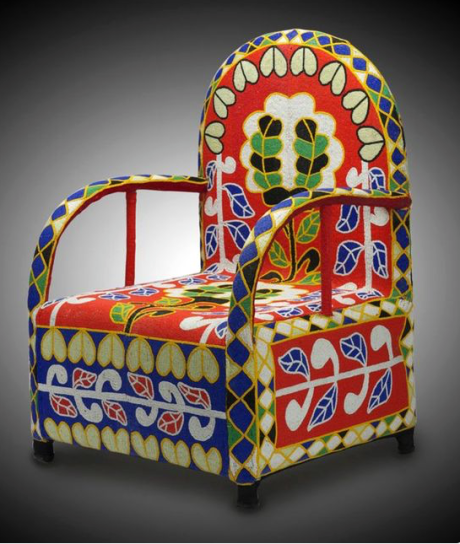
Yoruba People Beaded Chair Africa
The simple act of acquiring non-traditional school chairs can serve as a first step in de-institutionalized thinking about schools.
As long as it is acceptable for chairs to be insignificant, garish and poorly constructed, then everyone’s imagination and appreciation is diminished.
One way out of our current catastrophe is to consider beautifully, lovingly constructed chairs.
The adults change and the children change and it is all for the better inside an enhanced Circle of Children.
But for too many adults working in today’s USA classrooms, be they public or charter, these chairs would get you fired. Good luck finding an employee who attached significance to a chair, its artistry, composition or appeal to children.
But if you did locate such a humane individual, you would probably find them subject to the equivalent of a modern day witch hunt.
Imagination and Initiative are lethal. Anything that lives outside the realm of metrics and data massaging must be extinguished.
The cult of bean counters know how to look after their own and chair enthusiasts don’t belong.
It begins and ends with what Giroux calls “normalized ignorance”. The fog of crude, callow and empty gobbles up all available space. Chairs are ugly on purpose. No one cares about them and that’s exactly the point. In such schools, uncouth regimes remain as authoritarian sciolists. There is money to be made and beautiful chairs obstruct the cash flow.
A Bunny Chair will get you booted. You can bet on it.
And then there is the problem of going off message. Curriculum becomes a series of commercials on how to care for and preserve artful chairs.
Next, the Yoruba people arrive bringing with them a vibrant history of beading, braiding, tattooing, clay and ceramic molding, bronze casting, weaving, dyeing and sculpting.
When would there be time for War Room confabs, choking on bulging, black binders bursting with benchmark analytics?
We did this in Chicago and discovered great, small business people operating hair salons, hardware stores, rib joints and corner groceries. They ALL contributed to our neighborhood curriculum and it was an eye opener how resourced this impoverished community really was. Lots of smart people with an eye on education.


 kathyirwin1