Archives for category: Free Public Schools

zapatista-image1


The Brooklyn NY Sheepshead Bay marine biology classes took place during an activity of school closures and teacher strikes.  But these picket lines were peopled by unionized, public school professionals who had most recently gone south and volunteered in the 40+ Freedom Schools that had erupted in Mississippi and elsewhere, beginning in 1964.  These teachers knew better, had witnessed and survived mob violence first hand, and as a result, were not afraid of the NYC power elite.

The idea for those CRM ’64 schools began with other classroom teachers in Boston MA and Prince Edward County VA, who responded to right wing, racist resistance to the Brown vs. Board 1954 decision by refusing to cooperate with locked door policies.  Instead, they opened their own schools in off-site locations which became the epitome of liberated learning spaces, places where discriminatory facilities, textbooks, parents/teachers/administrators/elected officials, and curriculum held no sway.

In every case, social change was the order of the day.  Freedom schools were immediate and relevant, framing activism and investigation around local conditions that cried out for confrontation and change.  Youth attended but so did parents and intergenerational citizens.  Of course math, science, literacy, history, economics, civics and geography were embedded in all of it.  How could they not be?  But these were not empty, fragmented, reductionist, test-driven, corporate routines, passing for academics.  These subjects came to life as the entry points into activism on pressure-point issues.  All teachers were crystal clear that ignorance, illiteracy and incompetence formed the institutionalized foundation of separation, exclusion and oppression.

Today, it would be the same bitter wine but in newly branded bottles where the labels might read Race To The Top, TFA, Pearson, Common Core, ALEC, NCTQ, FERPA, Broad Foundation, or Vouchers and Charters.  But the 2015 reincarnations aren’t nearly as important as the essence that continues to promote and insure social isolation and injustice.  That multi-headed hydra is more than worthy of our eternal vigilance and our instinctive resistance.

In the case of Morris’ Sheepshead Bay marine biology classes, for some teens this was simply something to do while schools went silent and faculty on-strike.  Certainly there would have been typical teen grumbling that he or she had no interest in getting wet feet down by the bay.  The sentiment was that since we’d never explored there before, why bother now?  What does marine life or the pollution of the bay, its history or its economics have anything to do with my life, or my liberation, anyway?  Peer pressure and major NUDGing may have been brought to bear.

But the trade-off was the sight of sunrise over the water, and a story about the demise of oysters which meant the loss of the sheepshead porgy, and how we once ate what we caught right amidst the seaweed and salt marshes, fresher healthier and environmentally safer for adjacent communities.  There was the investigation into what REALLY happened to the Canarsie/Canarsee native people, a bloody legacy.  Following, was the discovery that slaves, and later emancipated slaves, were original founders of bayside villages since slavery was once quite legal in New York, among many other northern states.

Meanwhile, in other parts of the city teachers were exercising their professional responsibilities in determining curriculum and social behavior and they were free to be creative, without restriction, from a bureaucratic administration.  In fact, parents and teachers OCCUPIED some schools around the clock for the duration of a 1968 strike.

Principal Sid Morrison described that episode as a beehive in which parents covered administrative duties, helped out in classrooms and “slept-in” so the doors remained open.

Never before weekly meetings were held between parents and teachers to mingle, mix and discuss problems and goals. Classes became more relaxed and informal, and lesson covered a broader scope. When the strike ended, the group that had been active continued its investigation into changing the system in order to offer an enriched and more personal educational experience for every child.

From there it was a natural step into Open Corridors type classrooms where families contributed comfortable sofas, chairs, rugs, lamps and bookcases. Parents made games and materials for classroom use.

They built and painted storage units, painted classrooms, and provided pots, pans, measuring utensils, tools for workbenches, typewriters – all those items never before found in classrooms. Wardrobe trunks were fitted with casters and filled with colorful costumes. Incubators, sandboxes and indoor ponds were built. Animal cages and feed were donated.

Parents with media background worked with classes in doing films and filmstrips. Musicians shared their talents. Actors and dancers taught in their fields. The skills of sewing, cooking, carpentry work and teaching were utilized. A mini-market was set up in the school where children did comparison shopping, went to the wholesale market bought food, and learned to run their own co-op.

That was then but this is now, where we remain one long continuum of struggle, related as a family of inexhaustible, global energy precisely because we can link arms with each other at every stage of the push-back.

239BFJHS304-scope-X2

Active Learning And Activist Learning

What if Active Learning and Activist Learning came to mean the same thing at Michael Brown’s high school? Maybe Ferguson would not have been inhabited by an occupying army. Students with the support and guidance of authentic teachers, meaning not adults simply drawing down a paycheck and going along with the educational-industrial atrocities, would have called a meeting. Maybe Michael would have lumbered in to listen, curious, skeptical but reflective.
In this meeting, students would have announced that they were lives in search of an education, one they were not receiving in their current “reformist” situation. They would have made it quite clear that a rich man with theme park “budget experience” had no business being given a phony title and phony authority anywhere within their school district’s hierarchy.

They would have declared that deliberately impoverished school budgets and segregated learning centers were nothing new, just the old, stale, sick repetition of the same old bigotry.
Video, protest art, interviews, dance, drama and public media exhibitions would have begun to document what passed for high school in Ferguson. Out of control students, teachers, police and politicians would have been denounced and then put on public museum display for all to see and censor.

This is what Active and Activist Learning is capable of and it is exactly why we only catch glimpses of it on the cover of an aging newsletter from the 1970’s.

Rest In A Disturbed Peace All Ye Who Love Democracy!

As you might guess, there was no resting in the imagined Normandy HS.

Active and Activist Learning requires action, action that disturbs the peace and prosperity of right wing, reactionary eejets like a plutocratic-appointed “President Of The Ferguson Board Of Eduction”,  the Silver Dollar City Theme Park tycoon from Branson, MO and his state school board cronies.

The community of learners at Michael Brown’s high school recognized a colonial model when they saw one. Some secret somebody announced the arrangement one morning by gaining access to the Public Address system and airing an up tempo version of Gil Scott-Heron’s hit song, Johannesburg, with revised lyrics that inserted Fergusonburg. And for that week, What’s The Word? Fergusonburg! was the chorus chanted over and over in every hallway, assembly, food line and sports team warm-up routine.

Michael Brown had never heard of Johannesburg, Steve Biko or poet Dennis Brutus but his teenage school mates made certain that he began to listen up and learn. If Normandy High was to be their Robben Island, then there was a rich history of resistance that cried out for absorption.

The first rule of survival in such a degraded, Power Over Paradigm is self discipline, survival and unified action.
When Michael behaved like a bully or was spotted hanging out with the wrong crowd, he got called on it in a community meeting. He didn’t like it much. He even stomped out a time or two but in the end, he embraced the upbraiding delivered in his best interest. He was no bull in a china shop and he could not muscle his way through life in Ferguson. Though oblivion was a logical choice, his friends cautioned him not to get lost in a haze of drugs and illegal misadventures. They needed his intelligence, his humor, his loyalty, his affection and his strength. A dead hero is no good to no living body. These kids were fighting for a good life and Michael’s spiritual muscle was a Must Have.

It was in this fashion that Michael Brown might have begun to master the art of channeling his outrage at the conditions that surrounded him. He could have learned that he was not alone, an aberration, a menacing giant or a renegade. In the end, he did become a young man with a purpose, the very big purpose of revealing Ferguson to the world for what it was, an oppressive arrangement, repeated across our USA in countless communities of class and color.
Did you really think the Ferguson Teens needed to read that the White House authorized U.S. torture centers around the globe? Of course not, because militarization of the entire culture was obvious on their neighborhood streets day after day. It was crystal clear in the corridors of Normandy where students roamed freely outside of assigned classes while unable to read and comprehend the front page of USA Today. Time to take the bull by the horns.

Michael Brown first argued that he did not have time to tutor anyone but he was soon persuaded otherwise by his affirming affinity group. They would set up shop after school at the library, in a church basement or barber shop, using whatever was at hand to launch their improvised adventures into literacy. It was crazy, sometimes raucous and rowdy but these were effective sessions and they knew it. It felt absolutely RIGHT.

Numbers swelled and soon bands of teen tutors and tutees began a next logical step, mounting voter registration drives across the most under-served sections of Ferguson.

They fashioned themselves after the freedom-seeking literacy/voter movements on John’s Island SC in the 1960. They knew full well how literacy and grassroots empowerment were linked and they also knew that the cops would interfere the moment their work began to pose a challenge to the White Power Structure. What’s The Word? Fergusonburg! And in Fergusonburg it became a badge of honor to be stopped by the police and interrogated or threatened for distributing handbills that laid out the particulars on how and why to register and vote out the ruling junta.

Well, you know how youth are. They talk to each other. They post and twitter, message and selfie and before too long, surrounding public high school student bodies began to hear about the active/activist Ferguson learning movement. No one needed sanctioned internships or co-op experiences. It was not a self-serving resume citation they were seeking nor did they request official transcript credit. They knew the real deal when they saw it and they wanted in.

Soon, the P.D. was hassling the sons and daughters of hard-working county clerks, plumbers, beauticians and practical nurses. These parents were having none of it and so their dignity and influence brought an entirely new audience to the inhumane horror that was Fergusonburg.

When the private schools arrived, it really went viral. After a day of voter reg sidewalk pounding, the new recruits headed home with iPods and iPads full of video, audio, photos and Instagrams documenting the paramilitary protocols practiced in Fergusonburg.

These pampered parents were fast and furious with a response that rained official censure all over the pathological parade that passed for a community police presence in Ferguson. Talk about class warfare. The 1% were finally throwing their weight around someplace where it would do some good. A whole new world of energy, citizenship and inclusion began to take shape.

The desegregation of St. Louis County county took place spontaneously, outside the purview of court orders, as 2015 youth broke bread together, exchanged mix tapes and dance steps, played hoops and Xbox, toured each other’s homes and neighborhoods, silkscreened banners, placards, teeshirts and hosted teach-ins on how institutionalized racism is an economic arrangement benefitting only a malignant few.

Ferguson students of grassroots democracy artfully and courageously moved the details of their lives ever closer, until a seamless web was sewn that pulled everyone together in a civic embrace of inclusion and participation.  The spirit of Michael Brown was their instigator and their inspiration.

It’s a miracle Michael Brown even graduated from this beleaguered school!

By Mark Sumner @ Daily Kos

In Pluto’s diary on the life of Michael Brown, you might notice one detail that’s both touching and disturbing:
Mike’s graduation photograph was taken in March 2014, still many months ahead of when he would be able to graduate in August. Imagine the “why” of this fact:
The grinding poverty in Mike’s world only allowed Normandy High School to acquire two graduation gowns to be shared by the entire class. The students passed a gown from one to the other. Each put the gown on, in turn, and sat before the camera to have their graduation photographs taken. Until it was Mike’s turn.

What kind of American school would have to share robes across the entire senior class?
The kind that’s been the subject of a lot of attention from the state board of education.

This district was created by merging two of the poorest, most heavily minority districts around St. Louis—Normandy and Wellston. The poverty rate for families sending their kids to Normandy Schools was 92 percent. At Wellston School District, the poverty rate was 98 percent. Every single student in the Wellston district was African American.

Still, the state education board voted to merge the districts in 2010 (the first change to state school district boundaries in thirty-five years). Plagued by white flight, crashing property values that destroyed tax revenues, and a loss of state funds as the better-off residents of the area sent their children to private schools, the resulting district isn’t just short of gowns, it’s short of everything. Residents of the district voted again and again to raise their own property taxes, until their rates were actually the highest in the state, but a higher percentage of nothing was still nothing, and district revenues trended steadily down.

After the merger, the state board proceeded with the next step on their plan. In 2012, they rated Normandy as a failed district, removed its accreditation, and placed it under direct state control. The idea was to reform the district to the state board’s design, only there was one problem: the Missouri State Supreme Court ruled that students in a failed district had the right to go to other districts. Hundreds of Normandy students signed up to do just that, heading for classrooms in surrounding districts, some of which were majority white. At first, this generated tension:

News of the Supreme Court’s upholding of the transfer law initially sparked anger and fear among some white Francis Howell parents.
“I deserve to not have to worry about my children getting stabbed, or taking a drug, or getting robbed,” one mother said during a school board meeting, referring to the prospective arrival of Normandy students.

“We don’t want this here in Francis Howell,” another parent said.

But for the most part that attitude didn’t last. Normandy students settled in at their new districts, and despite a financial drain—Normandy had to cover the cost of transportation and pay tuition to the other districts for those students who transferred—things seemed on an upswing in the district.
…the remaining students and school community came together to celebrate a spirit of new beginnings. They held pep rallies and welcome-back-to-school gatherings. Students at Normandy High School said they began tutoring each other to improve the school’s academic ranking…
Indeed, walking the halls of Normandy High School at the beginning of the school year, there was a sense of optimism despite the dire state of things.

Well, you know what they say about optimists. Read below the fold for what happened next.
Funding the transfer students was costing the district more than it cost to educate students within the district. Part of that was transportation, but most of it was the simple fact that other districts spent far more on their students than the poverty-stricken Normandy district.

The state board of education took over the district’s finances, but rather than providing a new stream of revenue, they figured out a simple way to reduce costs:

On Friday afternoon, the board met in a hastily called meeting to change the Normandy’s accreditation status — or at least how that accreditation is described. Normandy now has “accreditation as a state oversight district,” the revised June minutes now read.
Get that? The state board, which had taken away the accreditation, now argued that Normandy was accredited, magically, without having the district actually meet any of the standards they had set. How did that happen?
“The Missouri State Board of Education, pursuant to its statutory authority to waive its rules, including those regulating accreditation, has accredited the Normandy Schools Collaborative and thus its schools,” the state’s motion to the court says. “Because of that accreditation, the Plaintiffs are not entitled to relief. … ”
The school is now accredited because the board has the right to ignore the law the board claimed it was enforcing in the first place, and parents now have no right to transfer their kids to another district … because the school is accredited.
Naturally, the case is headed back to court. And if the accreditation by decree isn’t enough for you, there’s another bit of magic applied by the board. That transfer law? It only applies to school districts. But see, Normandy Schools are no longer in a school district. Normandy schools are now in a special collaborative and, according to the state board, “are not in any district in this state.” So there you go. You can transfer from a district if you’re not in a district, and if you happen to be in a district, it’s magically accredited. Problem solved.

So who actually runs Michael Brown’s school district? Well, the president of the board of education is Peter F. Herschend of Branson, Missouri. Herschend isn’t a former teacher, or a former principal, and doesn’t have any training in the education field. He’s the owner of Herschend Family Entertainment, which runs Silver Dollar City and other amusement parks. He’s also one of the biggest contributors to the Republican Party in the state.

So, when you’re wondering who runs Michael Brown’s school district—when you’re wondering who’s in control of an urban, minority district so poor that the students have only two graduation gowns to share—it’s a white Republican millionaire from out state.

Black-Santa

Black Santa stands on Mrs Martin’s front Christmas lawn. She is the mother of one of my Chicago adult literacy students. She is also a transplanted sharecropper from Mississippi and the proud owner of a tidy bungalow in a big city, shoot-em-up neighborhood. She loves her illuminated Kris Kringle and beams his happiness every holiday season for all to see.
At her kitchen table she chuckles over old St. Nick and insists that every teacher should own a Black Santa for classroom display when Yuletide rolls round.

“You know good and well that no White Santa is coming down my chimney. In fact, no White Santa ever visits this part of town, so why pretend? I like to tell it like it is and Black Santa is how it is at my house every year.”

So I took her advice to heart and one day I purchased my own Black Santa. He is soft, cuddly, portly and portable and he has brightened up many a hard-working classroom over the decades. If a beginning teacher asked me to identify an important acquisition in behalf of achievement, I would certainly list Black Santa immediately.

My community messenger signals “family” and everyone who meets him, makes it a point to greet him. Lumbering fifth grade athletes sneak in to give him a handshake or to playfully confide their gift list. Little ones asks if he can share their desktop as they labor at a challenging academic task. Teachers drop in to say how much they enjoy seeing his joyful face. One day, a tough but tender scholar stopped in to offer her thanks for the act of incorporating a jolly elf of color into the life and work of her school.

Starting Points are not always Data Points. Gift Givers can be Santa Light Bringers who work a magic of cohesiveness using the Richness of Difference living deep inside the scope and sequence of our humanity.

Image

It was a Profitable Pre-Package Deal that Peter would not cooperate with. He must have smelled the stinky technocrats from the moment they entered the building, educational strategies, attitudes, process and procedure all mapped out ahead of time. There was no room for him in their construct, he sensed this from the git-go and instinctively would not tolerate the idea of this repressive history repeating itself all over again.
So, he rebelled. He had his own ideas, after all, his own assortment of likes and dislikes.
Admittedly, he could not read fluently or independently on his third grade level but there were things he could do that no one seemed interested in.  Why was that?

After all, he was fixated on a particular book and its illustrations. Didn’t that count for something? Shouldn’t his fascination find its way into the calculation of their literacy formula?
The answer was always the same. That title was not on the approved list. Approved by whom?
Approved for what reason, to distract him or derail him? 

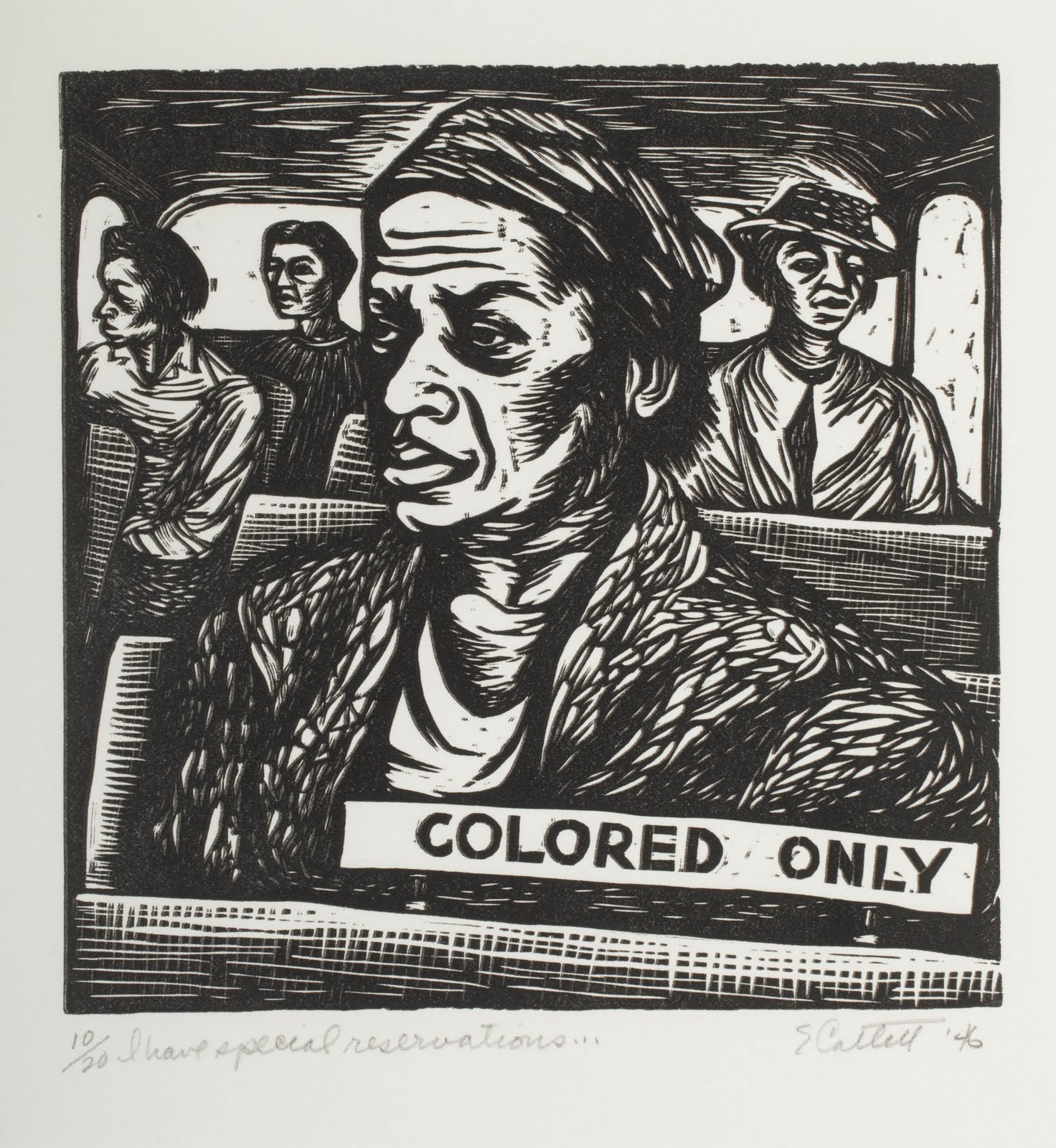
No, he simply would not participate in his own diminishment because he was in love with a collection of linocuts and lyrics that were historic, important and life-changing.  They would just have to deal with him as he dedicated himself to the mastery of this book.


Despite all efforts to the contrary, it went with him everywhere.  He would not let loose of it. 

Inside were pages of white copy paper upon which he traced and later freehand reproduced the compelling faces, the brave movements, the expressions of courage and resolve. Someone who did not agree with the cultish, university reading “experts” looked the other way while he sketched and scribbled. One day she took him aside and taught him how to sing the phrasings.

Lift ev’ry voice and sing

Till earth and heaven ring,

Ring with the harmonies of Liberty;


Sing a song full of the faith

That the dark past has taught us,


Sing a song full of the hope

That the present has brought us,


Yes, it was intended to be sung as a celebration of freedom and it was meant to be carved into blocks of linoleum and inked up for scratchy prints of personalities that were much like Peter, dignified and determined.  Elizabeth Catlett in 1940’s Mexico dreaming of Sojourner Truth, Phyllis Wheatley, Harriet Tubman and all working women tired of sitting at the back of the bus years before Rosa Parks took action.  What wonderful pictures flowed from the perspiration and inspiration of James Weldon Johnson and his younger brother, J. Rosamond Johnson!

Peter could not decode the book but he understood it. He felt the rightness of it in his bones. He hummed it and inscribed it until his memory embraced it, never to be erased.  And that was how he learned to read somewhere far away from the corporate territory inhabited by the “experts” who missed the miracle unfolding right under their scripted noses.

And as Peter sketched, another boy named Tilman was scheduled for permanent removal. He made the “piloting” of the literacy initiative look ludicrous by running up and down the hallways, unable to remain at a station or in a chair for more than five minutes at a time. Not one “expert” knew how to handle him and so he had to go.
Never mind that he should have been the poster child for how traumatized, impoverished students can learn to read.

There was no money to be made from the art and science of such an inquiry. Instead, a meeting was convened in which the foster parents and caseworker pleaded to no avail for his continuation at the school. No one at command central wanted to hear the story behind his coke bottle eye glasses or the cigarette burns inflicted on his backside by adults who will never deserve the title of “parents”. His was a sad but inconvenient saga as it posed real challenges to the master plan which wasn’t so masterful after all was said and done.
School Reform at its finest.

Image

Boom to Bust coal camps outside Morgantown, West Virginia contained a lot of starving families at the onset of the 1930’s.  They were so nutritionally ravaged that President Hoover dispatched Russian war relief teams to address the emergency.  Once fed, they grew hungry for more.  And so it was that John Dewey, Eleanor Roosevelt and the PEA recruited Elsie Ripley Clapp not to “reform” a school but to literally form one that spoke to people who were so far gone, they no longer believed in a place known as the USA.

This was an assignment for Educators, not for hucksters or empty-headed consultants. Standard cliches applied. The pedal had to hit the metal. Everyone had to fish or cut bait. Commonsense was imperative so, shell-game Common Core Curriculum cultists would want nothing to do with a project like this where competence and not a dumbo data point was the bottom line.

There were many dark moments for Elsie and her teachers, but even these were illuminated by one, very big idea.

The foundation of democracy is faith in the capacities of human nature; faith in human intelligence and in the power of pooled and cooperative experience.  It is not the belief that these things are complete but that if given a show, they will grow and be able to generate progressively the knowledge and wisdom needed to guide collective action.
Democracy and Educational Administration by John Dewey 1937

REFORM actually meant to re-form or restore the activity and the democratic promise of schooling. This was nothing that could be cured by corporate cultist consultants, lowest common denominator curriculum, races to the top (since the USA had already raced straight to the bottom of the economic barrel) in-Bloom or Amplify. Technological, hedge-funded, Microsoft cotton candy distractions were of no use. Good, hard-working citizen had been industrially and economically stranded deliberately by Wall Street and there was no quick fix for sale anywhere.

So, teachers stepped in because back in those days they were still allowed to think, problem solve and create from chicken scratch whatever was required.
Things were so bad that Hoover brought a bunch of bright lights to Washington DC to take aim at the travesty of starving children in a multitude of coal camps and communities across the not so great nation state. The very first interventions were based on getting the victims busy in their own behalf. No institutionalized passivity would prevail.

Playgrounds were built in the middle of debris fields and gardens were planted in washtubs and slate piles.

Families learned to can and preserve the food they’d grown and sometimes they learned all over again how to cook with fresh ingredients. Civilization had fallen away and had to be re-energized. It was a job for educators who weren’t afraid to take on the rehabilitation. It was multi-faceted and known by many names: community school, school as community, community-based learning, community in schools, and school at the center of community building.

Lucy Sprague Mitchell had taught waves of real teachers to wander the neighborhoods in search of resources for learning and investigation. The coal camp faculty followed suit and discovered devastation. In February of 1934, a woman with hands blue from the cold was found hauling a heavy basket up a steep hill of ice and snow to a shack unheated and un-electrified. Come July of the same year, a neighboring cabin revealed a dying infant covered with flies and families living in small, squalid rooms surrounded outside by abandoned tipples, collapsed coal shafts, empty company stores, broken glass fronts, rickety porches, cinder heaps and listless, worn-out lives.

A rotting shell was the starting point for these determined pedagogues. Fetid, crowded steaming heat in summer and bitter, desolate, paralyzing cold in winter presided over a contingent of public privies, polluted water wells, saloons, brothels and idle intellects.

This was not the time or place for fixed subject matter, ready-made rules, standardized test schedules, data aggregation, fragmented fact memorization or mass produced, superficial mustard plaster solutions to slow, difficult, complex social problems.

Image 

Lynne Martin Describes How It Was When Teachers Were Teachers

Tried and True Alternatives to NCLB, CCSS, Amplify, Pearson and the Current Corporate Catastrophe

One of the ideas behind our school was to do the very best we could in hopes that it could also serve as a kind of beacon to other schools.  Not in the sense that we were better than others but because we had some kinds of freedom that the public schools did not have.  We hoped we might be helpful in that sense.  Books were published on our curriculum during the early days.  I still have some of them and they are so precious to me that I’m scared to lend them out. 

The Course In History

The Morning Exercise As A Socializing Influence

The Social Motive In School Work

All of these were part of a series entitled, Studies In Education, meaning to summarize and reflect on what was being done. Flora Cooke wrote the introductions.

The Morning Exercise was our daily getting together of the whole school.  These grew from Francis Parker’s practice of holding town meetings with the students.  It started as the entire school coming together everyday at around 10:30 for about thirty minutes. The program would be some grade sharing something they had learned, or were studying, either through music, drama or poetry.  It is a lovely tradition however you can manage it.

Let me give you an idea of how things could work.  I am reminded of one time when one of my kids brought into school a dog’s head…a VERY dead dog’s head.  He’d found it in Lincoln Park and it stank but it was a treasure!  So, after the beginning of the day I put it in a plastic bag and hung it outside the window so it wouldn’t smell up the room. After that, the Science teacher came and he was just great about it.  He took it home and boiled it and then brought it back and here was this beautiful, little skull which was so nice for the kids to see. 

There also was a time when I required that at least once a week, everyone would bring in a drawing they had done of any natural thing.  It could be a leaf or could be a shell; anything really because I had the idea that city children do not see.  There is an awful lot that is ugly in a big, bustling city and there are so many things that no one wants to see.

I think there is value in the simple things, simple things like making leaf prints or rubbings with a flattened crayon.  Bring to their attention any kind of thing that you run across like a wasp’s nest, a piece of lichen, or a mushroom that you pass when walking down a sidewalk.  This practice is particularly important for city kids.

As for planning, I just assume that a teacher has in mind a prepared skeleton of first ideas she intends to present and explore.  I used to get kind of scared of those people listing endless objectives, as if they knew EXACTLY what they were going to teach.  More it is about putting a question out there and then seeing what comes of it with the children. 

This is how we discover what they need to be thinking about.  Over the years, I developed a series of binders outlining and detailing the sequence and activities by subject.  Here is one for Geometry and another filled with ideas related only to Math.  I had one for Language that might not include every activity for an entire year but certainly those ideas that got me thinking about a new or good way to go at something.

A teacher’s skeleton might include some of the ideas she thought were terribly important for children to have thought about on a particular subject.  I would start by thinking about what interested me, as an adult, about a topic.  And then I would try and try and remember what caught my interest as a child.  The resulting list wouldn’t necessarily mean that they would investigate everything. 

Teacher would also have a clear idea of a progression she intended.  For instance, by the end of the year in Math she would expect that three fourths of the children could do the such and such following operations.  She would build from day to day, creating the spelling lists central to whatever theme or topic was under study.  She would identify the age-appropriate scientific questions for experimentation.

I saved the children’s writing for them in a file until the end of the year.  I always kept my own records and I gave my own tests.  I reminded them that I was testing to see how well I was teaching something.  If they did not know an answer, it was not because they were dumb or weren’t paying attention; it was because I wasn’t teaching well.  I gave a lot of tests that were open book…you could go and try to find the answer.  It is very important for kids to have a chance to learn how to do that.  From time to time let’s say, I’d give a little test on the multiplication tables and I would keep a record of what they had or had not mastered.  We wrote narrative reports and there I might say that “He tests in the upper 4th grade level within a very able group of students.”  Or, “He is in excellent shape in all things with highest in ____and lowest in ____.  But I notice…”

I never read the record of a child before school began.  I didn’t want to be impressed by what somebody else thought about a certain child.  I wanted them to come fresh and new to me.  But I did tell the parents, “I do want to know anything you would want me to be watching out for or to be aware of.” 

4th Grade studied the Greeks.  When I started teaching it, I brought in the other ancient civilizations out of which the Greeks began.  I concentrated on the Greeks in 2nd semester.  We would do plays in costume and I did not use textbooks.  I used original sources.  I would read to them Greek tragedies.  We started out with the formation of the earth and then primitive humans, cave paintings and things like that.  For forming the earth we’d go out and look for fossils and discuss their possible evolutions. 

I had loads and loads of pictures and always put them up.  We would go over to the park and sketch the bison, comparing it with the Lascaux cave paintings.  And then we moved on to Egypt not because it was the oldest but because it was the simplest of ancient civilizations to approach as a thematic unit.  We learned about the Fertile Crescent and I would have them pick any Old Testament bible story that they wanted to research and write a report on it.  We had children from many, different religions so we used these stories as literature.  For instance, they could use the flood story and I would then tell them about the excavations at Ur where there are traces of a once great flood. 

We studied Hammurabi around the time of Abraham. I had them keep a time chart of key characters and I gave them important dates to include, with details.  We’d add on to these every few days and used them to think in terms of time and how things change but not in the sense that they had to memorize it all.  I used to create crosswords using dates they could then look up on their time charts.  Using the cross number puzzles was a way of helping some of those dates stick without requiring that they learn them by rote.

I remember that around the time of Christmas somebody would ask, “Now what was happening in Egypt around this time of year?”  I had Histo-Maps.  Do you know those?  They are wonderful things.  You can get them at the Field Museum.  They show histories pictorially, histories of civilizations.  So, we studied the Fertile Crescent up to about the time that the Persians were poised, at their peak, looking toward Greece.  Then we went all the way back at 2nd semester and studied the Minoans, the Miceneans and then historic Greece up to the death of Socrates.

Here is a source I used during 1st semester, Ancient Near Eastern Texts Relating to Old Testament, Editor James B. Pritchard, Princeton University Press 1955. 

I would use this and shorten some of the most ancient stories and then produce one as a play for a Morning Exercise performance.  I did a lot of summarizing, cutting down, mimeographing and giving children copies of the original versions of ancient things.

I had a strong feeling that if you were asking them to write beautifully, you needed to give them the experience of beautiful words.  In 4th grade we learned cursive so our daily handwriting practice, wherever possible, came out of the literature of the people we were studying.  Inevitably, during the formation of earth, someone would say, “There ain’t nobody to be quoted.”  So, I always gave them, “And the earth was without form and void…”  Lines like that are what we used for handwriting practice and I kept them all in a binder full of typed quotations, spanning historical topics for the year.  This gave them short fragments of something lovely to work with.

I built up quite a collection of artifacts.  I’ve got everything from lava that Leakey found in a gorge to reproductions of very old things.  After a few of the more fragile got broken, I learned just to carry them around so children could look and touch.  It is very important to do this.  And it takes time to build up good supplies and to know which you really are going to need and use.  None of this should be rigid because things change as the teacher learns something new about a subject and incorporates it. Parents were given the dates, roughly, for when we would celebrate a birthday like Apollo’s and for that a father came in with his little Irish harp and played a fragment of ancient Greek music. Once parents come to know they really are respected, you come to find out that they have talents that bring great value to the classroom work.
We’d put out a notice saying, “This is the theme. Is there anything you might be able to contribute during this quarter, related to this topic?”

After I’d been teaching the 4th grade unit on Greece for awhile, there was a magazine article saying that I’d never been there and it quoted one of my students as saying that when he grew up he would be sure that he took me to Greece. About six months after the article appeared, I got a letter from the Greek government inviting me to come for a visit. So, I toured for six weeks. Pure Cinderella! I went during the summer, visited a camp and met with their country’s head of education. I inherited the 4th grade Greek theme but I could make it anything I wanted to.

Lynne Martin was a teacher for 30 years at Francis Parker School. She was noted for her teaching of the culture and history of Ancient Greece.
The government of Greece honored her in 1960 with an all-expenses-paid trip to that country.

She was interviewed in Chicago by Kathy Irwin.

Children’s playscapes are often messy, ingenious spaces cobbled together from whatever is at hand.  The embodied intelligence and determination is obvious and always worth following and learning from.
One hot, basketball hoop day some city boys took me on a tour of their neighborhood.  They meant for me to know how it feels to trudge through a succession of courts only to find each one damaged beyond repair.  We saw surfaces graffiti-ed up with gang signs and swear words, iron standards pried and pounded loose from their concrete bases, equipment hanging cock-eyed and at crazy, impossible angles.  Metal nets were torn apart and shredded with what must have been a crowbar, so that shards lay scattered on the ground with remaining links hanging limp in function-less rows like wet strands of dirty spaghetti.  It was so discouraging.

“This makes me want to throw up,”  I told them.

“Us too!” they insisted, nodding their heads in united agreement.  “Nothing we can do about it,” they muttered in angry disgust.  “Bums or big guys tear everything up.  Go look at the sandbox over there.”

I did take a peek at the sandbox – yucky, gross and very dangerous.  What once was a spacious wooden box of pine planks and comfortable ledges for sitting and digging with sieves, shovels, molds, scoops, tablespoons and fingers was now a ghastly garden of shattered glass, liquor labels, cigarette butts and junkie syringes.  Where cups of water from an adjacent fountain once encouraged the early science formation of mountains, mounds, hills, valleys and riverbeds, now only the overpowering stench of human urine puddled and pooled across the sandy expanse.

Maybe somewhere a Parks Authority Person could lean into a big map with a boast and point out the multitude of well-provisioned recreation opportunities, strategically located, available to all, discriminating against no one, equalizing the playing field for everyone but really it was a big, fat insult in the last analysis.  Yes, an insult and an eyesore to erect a Big Rock Candy Mountain and then allow all the yummy surfaces to remain covered with people debris and dog droppings.  Don’t Touch.  Don’t Explore.  Don’t Enjoy.  Don’t Return.

In the end, it was a big brother who took affirmative action. He and his friends confiscated a solid beam from the demolition salvage of a once elegant apartment greystone. The beam, standing over 7′ tall, was nailed into a platform of pallets discovered at the backdoor of a grocery store. To the underside of the pallets four wheels were attached, these liberated from a dolly at a nearby warehouse. The net was fashioned from a bright blue milk crate with its bottom carefully removed so no rough edges interfered with artfully executed slam-dunks. The contraption was then rolled into any street or alley space available for a game of pick-up and tucked away at night where no one could dismantle it. Amazing to behold.

Image

Classroom James Van Der Zee Dignified Classroom

The cafeteria is percolating with lunch time fifth graders eating, laughing, chatting and sitting at tables like diners do. It all would all look comfy-cozy except for the backs of students who line the walls and ring the room, with noses pressed firmly into cold, sterile concrete block, policed by two adult males. For the offense of speaking too loudly, they must now assume the position of statues or prisoners from an old Jimmy Cagney jailhouse movie. On punishment, they probably won’t be fed this day unless it is covertly by the kitchen ladies. The administrators, who established this “consequence” as standard protocol, have flown to Boston for a celebratory meeting with their national, school reform cohorts. What a waste of plane, hotel and restaurant fare but so it goes for the do-gooders. Instead of the big front lawn sign celebrating this fine institution of learning with a phony rating proclamation, maybe they should call it what it really is, education defamation. It gives everybody involved in the profession a bad name.

I point this out to them upon their return which, of course, they deeply do not appreciate. I suggest that should there be a spot-check by any unscheduled foundation officer, the J-Block image just might burn a bit too brightly as a summary memory. Clearly, I have not caught on to how things are done in the lucrative world of philanthropy. But it turns out that I am not that slow a study. I get the picture pretty quickly.

First, it is all about the money. Any charade, any atrocity, any act antithetical to the loving development of creative human beings is tolerated as long as the finances keep flowing. Naturally, the Potemkim Village must be erected within an impoverished community but the mistake here is that this really is a community, an old one dating back to the early 1900’s.

Here, Citizens own their small homes, maintain productive gardens, operate businesses just down the block and pay attention to the school that sits right across from several front doors. One day a boy walks in and asks me if I like homemade cabbage rolls. I stare at him in pleased astonishment and assure him that it is one of my all time favorite meals. The next day I am presented a foil covered plate loaded down with cabbage rolls, pinto beans and cornbread. Heaven on earth is my reaction.

I am also visited by a grandfather who thanks me for signaling “Science” by installing an outdoor display of rock and mineral collection, pine cones, acorns, potted mint, chives and assorted bird nests, He assures me that everyone wanted me to know that they’d be “keeping an eye” on things. I concluded that the individuals looking out for the intellectual welfare of these children were large and in charge but not employed by the on site bureaucracy.

Although Black children filled the corridors of this school, Black History Month was ignored by the majority of White teachers, who later would prove quite adept at turning the place Green in anticipation of St. Patrick’s Day. Suspecting this in advance, I summoned the ghost of James Van Der Zee with a postcard exhibition of his Harlem photographs which resulted in a tearful mother hugging me in thanks for the dignified portraits of her “people”.

What kind of improvement society ignores the most empowering achievements of those they are supposedly in service to? One that benefits from things not improving!

Image

If I Had Five Bucks did not have two plug nickels to her name.  But her financial fantasy displayed both age-advanced computation and an endearing generosity toward her equally impoverished peers.  She reminded me of a destitute Michael who once liberated fifteen dollars and then immediately met up with his classmates in the lunchroom where he bought them all a round of ice cream bars, fancy pencils and decorative erasers. 

Money and Morality go hand in hand.

So do Hull House and Honest Abe, it seems.

Naturally, the locked closet concealed a basket of freedom fighters.

Jane Addams, Abraham Lincoln, Crispus Attucks, Betsy Ross and Harriet Tubman Hand Puppets were historical strangers to these children but that was about to change. 

Before a round of courteous introductions could be completed, Jane and Abe were snatched up and born into brothels. A helplessly, wide-open-to-the world seven year old, being raised in what 1909 Addams described as “The Wrecked Foundations of Domesticity,” seized an opportunity to cry for help by staging an intimate revue in which Jane and Abraham engaged in vivid dramatizations, complete with grunts, groans, exclamations and anatomically-correct contortions. 

I immediately reclaimed the puppets and returned this enthusiastic audience to a chapter out of Twenty Years At Hull-House in which Ms. Addams described the influence of Lincoln upon her childhood.  She was four and a half years old when, for the first time, she stumbled upon her father sobbing grown-up tears.  He told her he was crying because the greatest man in the world had died.  She was stunned, never forgot the moment and developed a life-long admiration for this martyred president. 

After that, she made a practice of standing out in the family apple orchard, scanning the skies and hoping for a glimpse of the famous Eighth Wisconsin Regiment war eagle known as Old Abe. When the aging bird failed to appear, and after many appeals, her father drove her to the state capital where she finally met the feathered veteran of thirty-six Civil War battles and skirmishes.  It was there that John Addams turned to his daughter and said, “You must never forget that Mr. Lincoln believed in the American form of government.  He thought that it could make a better world.  He believed that every man should be equal under the law.  Mr. Lincoln held that ideal before the nation, as the soldiers held the great eagle before the regiment.  We must make this ideal come true.”

And who will preserve that ideal for our seven year old playwright?  When questioned about the circumstances of his home life, grade level team leader, guidance counselor and assistant principal all admitted to full knowledge of the horrific circumstances.  As to why none took action to protect this acting-out vulnerable one from his abusive over-exposure to adult life, the answer was simple.  They had marching orders to focus on a test score bottom line that had nothing to do with the birth of a new world.

This morally-empty accountability movement they’ve embarked upon provides them the absolution and abdication necessary for not acting in behalf of significantly human lives. Finally, lest we believe that our born into brothel 7 year old holds no significance or promise, we conclude with an excerpt from his homework journal in which he describes an after school adventure connecting nature science and neighborhood.

A moth is different from a butterfly. How? Because a moth has hair on it and a butterfly doesn’t have hair on it. Cause when me and Glenn found a light green caterpillar at our apartments, it was hanging upside down from a spider web.


And Glenn said, “Look, a light green caterpillar.” And then Glenn said, “Hurry up and take it off the spider web.” And then I took it off of the spider web and gave Glenn the caterpillar.
And me and Glenn ran around the corner to my house and I went up the stairs and digged out a box. But the caterpillar couldn’t fit up in there because we really had big leaves.

Then I had a problem with my sister’s bike because it rained over their in town and I stayed over their trying to fix it. Then Glenn had went to a lady’s house that he had showed the caterpillar to and she gave him a jar. It worked like a magnifying glass and it had the top on it and had some air holes around the top.