Image


Christopher is 4 years old and frequently grown-up angry.  One morning he stomped out of his classroom and into a restroom area down the hall.  Suddenly aware that I was nearby and watching, he turned to me with a jerk and shouted, “If I am mad at somebody, I just look at them and say, ‘Hey Bitch!’”
 
I clamped my hand over my mouth to keep from laughing and considered carefully before responding, the fewer words the better.  “Guess I just never say it.”
 
“What?” he replied in a rapid-sharp voice.  “What do you mean you don’t say it?”  Surprised I wasn’t reprimanding him?  Wondering if I was telling the truth?  Curious if I had an alternative to his harsh way of talking?
 
“I simply don’t speak to people that way. It does not come out of my mouth.” 
I delivered this with a silent, shoulder shrug and pretended to get interested in a developmentally inappropriate, preschool worksheet stapled to a bulletin board.
 
Since his outburst didn’t provoke me, he immediately abandoned it and became absorbed in the water fountain, turning it on and off and diverting streams of water with his tongue and his fingers, in other words, exploring the properties of water.  It was a soothing diversion and ultimately calmed him enough that he could walk back with me to rejoin his friends.  Too bad there wasn’t a water table set up as a workstation for this little man with the mouth.  But those also have gone by the  Leave Every Child Behind wayside.

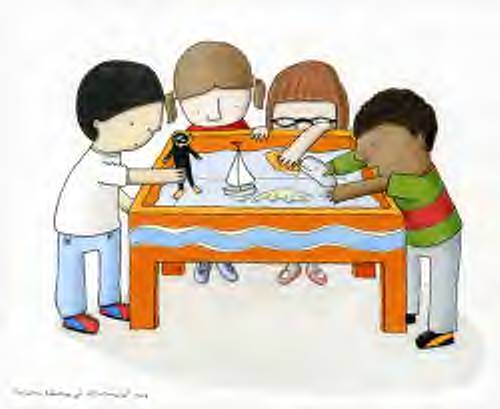
Alternately, Jorge healed himself at a water table.  He arrived for a visit, having lived in 10 different foster homes before his fourth birthday.  His hyperactivity and anxiety were so extreme that no family could soothe him or survive him, therefore he rotated from one placement to the next.  Prescribed a steady dose of Clonidine, you wouldn’t have known it from the way he ran directly at a solid wall, smacking full force, face-on and then collapsing in a fit of giggles.
 
It was the water table that drew his attention.  The girls usually commandeered it, washing baby dolls or dishes, transferring liquid back and forth from tea kettles to jam jars.  Most days, boys weren’t allowed but somehow everyone knew Jorge was different and for him the rules did not apply.  He spent two weeks standing behind the crowd of girls listening in on their conversations.  He always wore a smile, sometimes nodded his head in agreement with an opinion expressed but never edged past the periphery of bodies to join in the fun.
 
Then the earth’s orbit shifted and his hands slipped into the delicious drench.  There was no budging him after that.  He was polite, always patient and ever alert for that perfect moment when it would be okay to slide into place.  He had figured out the human arrangement and was careful to comply in ways that guaranteed access to the dreamy drink.  There he would vibrate in endless delight, stuttering less and speaking more, solidifying an identity and a circle of friends who did not fail him.  In the water he learned how to become.


Image


We have been told that this student is not legally entitled to any more “Special Treatment”so we are returning him to Kindergarten.  At this Title I school, a four month sentence in administrative isolation is called Special Treatment.  J-Block is what they call it in the adult prison system.
 
SPECIAL TREATMENT
 
A five year old boy shut up in a tiny room from November to March.  Imagine!  Each and every day meant no recess, no Circle Time, no eating at a big table with other children.  The simple, socializing joys that he so urgently needed were extinguished before ever being experienced.   
His special treatment was a purgatory called In School Suspension where he was cycled through the same worksheets day after day, memorizing how to count and color Pilgrims, Native Americans, cornstalks and hay bales.  On a b&w gingerbread house, he graphed crayon-coded gumdrops, candy canes, sugar plums and butterscotch wafers.  He cut and pasted columns of numerals in ascending and descending order.  Over time, he got very good at this flat work. 
In the early days of his confinement, he defied the ruling junta by grabbing a chunky-chubby black crayon and scribbling over every detail with such ferocity that he shone with perspiration before finishing.  One day I pried the frustration from his fingers and smoothed his determined grip into a relaxed receptivity.  “Let’s start again and make one of these beautiful.”
We began by taking turns, bent over and absorbed as if collaborating on a paint-by-number, John Henry Man Versus Machine. We chatted away like the most synchronized of study buddies.  “I think I’ll make my sky mostly blue with some white mixed in.  May I borrow the green when you’re finished with it?  If we cut right along the big, fat line I think the teacher will be able to read the numeral.  And remember we’re only using baby dots of glue.  Baby Dots Not Glops! That’s our motto.” 
This was satisfying work, repetitive but civilizing and the only preparation there was for a return.  It took all of November to gentle him and after that he followed every rule of customary deportment but still was not permitted to even visit the Kingdom of Kindergarten until the end of February and only then with me as bodyguard. 
But then came the March Declaration of Special Treatment when he was abruptly dropped behind enemy lines, told to sink or swim, and forced to jump with no back-up parachute.  It was a perilous insertion.  I would hear him wailing in protest across the vast, central rotunda., screaming and kicking in protest as he was drug, adult escorts on either side, always back like a boomerang, no matter how successful the launching. 
I can safely say that he remained in this disruptive dance until May. Another boy from the same grade level remained in ISS from November until June, a total of six months. No field day for this one, no end-of-year picnic, no parade through the hallway with happy noisemakers and hip-hop music to celebrate the going home.  The piped in soundtrack was joyous and my young sidekick sparkled with an excited grin as he showed me his talented dance moves while dutifully stationed in his chair. 
Most importantly, this was all off-the-books.  The district software repository for registration data, grades, attendance records and disciplinary infractions revealed that none of the in-school months of classroom separation were ever recorded for official eyes. Intentionally, the long haul was virtually untraceable by state and federal authorities.  No one will ever know that no one knows what they are doing.
This organization hurts children.  It retards growth and it injures spirits. The logical conclusion of its terrible trajectory is a chaotic country full of incapacitated citizens.  But the reality is that situations like this are scattered across poor neighborhoods throughout the United States.  Led by CEO’s/Chief Education Officers and propped up by well-paid corporate consultants, policy wonks and super-rationalized schematics for “school reform”, these folks don’t intend to be re-fashioned or fixed.   In fact they financially benefit in a very personal way from funding formulas that follow their failure. Here, terrible is profitable and a good way to go. 
 
 
We can whenever, and wherever we choose, successfully teach all children whose schooling is of interest to us. We already know more than we need, in order to do this. Whether we do it must finally depend on how we feel about the fact that we haven’t so far.
Ron Edmonds Telling It Like It Was And Like It Is!


Bath_5684

Bathe The Baby

In another time and place, curriculum and NOT incarceration was the prescription for what ailed us. Dezzy was one, out-of-control bundle of beautiful.  When she smiled the entire world illuminated and a hyper-vigilant intelligence beamed from her deep brown eyes.  But she was Dezzy and that spelled upset most of the time.  The uncharted, non-standardized curriculum adventure was to find interests that became the absorbing object of her attention, anything that sustained concentration was a starting point for this three year old.
Her world really was a Ghetto, a violent one where she embodied the trauma and vibrated from repeated, parental power struggles which inevitably melted down into screaming, yanking, spankings and puddles of hot tears. Naturally, her reflex was to reproduce the drama but this dynamic did not serve either her growth or her gifts.
Birth order was a big problem as she longed to be an only child but instead was wedged between an older sister and a toddler brother.
Attachment between daughter and mother was tenuous and the tug and pull of wills was something to behold. However, our darling girl loved babies and baby dolls and desperately wanted to be viewed as competent and to be complimented on her skill set. So, no surprise that one of her favorite roles became that of reliable caretaker, otherwise known as Queen of the Baby Minders.
Queen Baby Minder was equally regal and bossy. The other children rightfully objected when she seized the community water table ordering everyone about, hence the purchase of a bathing basin where she ran the show without interference. Ours was not a Baby Beluga requiring fathoms of deep, blue sea so Dez learned to measure safe amounts using a calibrated plastic lab beaker. 
Were we boiling potatoes or replicating the Polar Ice Cap?  Of course not, so which number on the thermometer constituted a moderate lukewarm?
Babies need accessories, lots of them and the use of each item helped Dezzy comprehend the household economy of cost, care and conservation. Our Bathing Cabinet eventually included sponges, infant soap, shampoo, oil, washcloths, hooded towels, diapers, powder, wipes, baby scale, bulb ear and nose aspirator and an oral medicine syringe.
Each item had a name with a vast universe of language and experience attached to it. Over time, this Three acquired a much more sophisticated vocabulary than the unrelated, alphabetized list of reform-driven sight words that the Special Treatment children rebelled against regurgitating every single morning on their Kinder carpet.
Bathing the Baby allowed Dez to soothe herself, to behave lovingly, to memorize the lyrical emotions of bath and bedtime lullabies and to practice the gentleness that she was too often denied in her own stress-filled family. Slowly, her fragmented self became integrated enough to join groups of others who welcomed her into their learning and their play.
Tantrums vanished as social negotiation emerged.  Exclusion or banishment to an isolation tank would have made her estrangement that much more acute, reproducing her affliction but not remedying it. She became a student of life by remaining in the company of others and acquainted with herself while in pursuit of what interested her.

kids-cityThey are shooting in the projects again! My home looks like a bullet-ridden section of Sarajevo, only here there will be no peace-keeping forces to provide us safe passage. On the first day of school we will walk or ride bikes over spent shell casings, shattered glass, bloodstains and abandoned auto parts, hoping we don’t get caught in anybody’s crossfire. Other kids with shiny faces just like mine, in nicer parts of the city, will travel safely and confidently to their education destination. There won’t be one ounce of fear swirling in the pit of their stomachs, no hyper-vigilance, no need for eyes in the back of their heads. I pretend I am a stealthy Ninja with secret powers. I breathe deep from the core of my being and try to remain calm and alert because that is how I will stay alive.

When I get to school, if I get to school, breakfast will be waiting. It will be a good breakfast which I don’t want to lose due to a nervous digestion. Last year, someone at cafeteria headquarters tried sending us donuts and sugary cereal but The Moms wouldn’t have it. There were big arguments and tons of rowdy meetings which resulted in The Moms retaining control over our meal program. That means my morning menu will include some rotation of true scrambled eggs, homemade biscuits, sausage or bacon, juice, sliced fresh fruit cup, pancakes flipped on a grill, hash browns from peeled potatoes, toast out of a toaster, tacos rolled by hand, oatmeal with raisins and cocoa scented with tiny marshmallows. In other words, real food prepared from scratch by real people. Maybe this is the love + nutrition that we require in order to survive the violence outside. Lunch is much the same with salads we actually eat and an absolute minimum of processed foods. Believe me, I dream of these meals and I smell them in my sleep, when I can sleep, which is when the gunfire isn’t so loud and relentless.

Lots of schools around here won’t open this year. They have been turned into private academies, charters or sometimes even into condos. Once they were known by famous names like Harriet Tubman Elementary or Cesar Chavez Junior High or Julia Richman Senior High but that’s all gone and forgotten. Others were bulldozed to make way for apartments that no one around here will ever be able to afford, leaving us surrounded by strangers with historical and social amnesia. Last week some kids got letters saying their district was out of money and couldn’t say for sure when things would start up. Parents and teachers marched down to city hall and picketed with big signs but so far, nothing has changed. The Moms call it a standoff that we are lucky to be out of, but now I worry every time the mail arrives that we may be next.

Yesterday, a shooting happened right in the middle of a basketball game at the community center. Two guys were killed so now that gym is off limits and there is yellow, crime scene tape everywhere you look. I am sick of it. I want someplace safe to play where parks aren’t gang turf, ball diamonds aren’t vandalized, and recreation workers aren’t furloughed leaving us with no bats, no balls and no umpires. Is that too much to ask? I’m trying to have a childhood here. What playground space there was at my school, got turned into a parking lot. It wasn’t much to begin with since the junkies used it at night for shooting up, leaving infected syringe litter all over the blacktop. Our adults had to sweep all that away which was yuck, to say the least. But then one morning drug guys came roaring around the corner, leaning out of car windows with sawed-off shotguns. Their fire fight got so crazy that staff cars took bullet holes the size of frisbees and that was the end of off-street parking. Now if we want “recess”, the neighborhood men escort teacher and students a block over to a green space where we run like the wind, while they watch our piled-up jackets so nobody steals them.

The grownups look proud of us when we step out into the community and they should because they have lots to be proud of. Plenty of them own their own homes and keep the front sidewalks as clean as a kitchen floor. They plant flower and vegetable gardens and run businesses like tire shops, sandwich shacks, beauty parlors, parking lots, car repair, even an old hardware. I take walkabouts, I pay attention, I listen and I ask questions. I’m curious about what they do and how they keep it going year after year. I know just where the hardware store is located when our class project calls for batteries, magnets, pulleys, mirrors, scales, electrical switches, sandpaper or seed packets.

We even have a library that sits in the middle of a burned-out block. It looks more like a bombed-out block but at least it has stayed open and busy for nearly 100 years. Its name is the Frederick A. Douglass branch, with art deco designs on the first floor and a theater in the basement. Yes, a theater for stage plays with curtains, microphones, lights and speakers that let audiences hear what is being said. Last year a rich man came to visit us at school. He said he had grown up nearby, with a dad who was killed in an accident and a mom gone all day at a factory where she sewed clothes. He didn’t have much to do for fun so he hung out at this library. They got to know him so well that the ladies collected books about things that interested him which was mostly snakes. No matter how lonely or invisible he was feeling, he knew there would always be snake books waiting for him at the big, circulation desk. That made him feel like somebody and eventually, he grew up and became somebody. I believe his story because this same library acts the same way to this very day.

The violence I encounter takes place inside my safety zone, on streets I know very well, in front of people who recognize me and look after me. I’ve memorized how to duck and cover and I have a choir of angels making sure I stay in one piece. But what about the kids who have lost all that? How many of them will get hurt before someone figures out that it is never safe to make children strangers in a strange land? Their nearby schools have been shuttered and where they now must go, they have never been before. When something jumps off, because it always does, what then? Who has their back and who protects their heart from feeling frightened, lost and alone? It is scary enough to walk past a familiar homeless center, housed in a church basement, and watch angry men with sticks and clubs push down the steps and into the shelter looking for someone they want to beat up. What if you don’t know the location, the director and the clients, like I do? It is a peaceful, positive, protecting program…most of the time. But when that’s not true, a child’s imagination takes over and nightmares begin and the journey to school turns terrifying and everything connected to learning becomes just one, long-lasting anxiety attack. And don’t get me started on the rival gangs, their colors, signs, turf and trouble. Ask around because the parents of these kids are affiliated members who don’t like each other and who kill each other regularly. That definitely will not change anytime soon.

Mary was a little lamb

Her fleece was white as snow

She got assigned to a dangerous zip code

Where grown men feared to go.

So we followed her to school one day

It was against their rule

But who would route her life this way?

Only a bureaucrat or a fool.

It made the children scream and shout

When the bullets hit the wall

We tried to cover Mary, but too late,

We watched her fall.