Each individual bubble is a tiny object in a vast ocean.
But together they influence the upper ocean.
Bubbles generate sound when they form and scatter sound. Bubbles change the colour and transparency of the ocean because they scatter light. Bubbles act as small vehicles transporting gases through the ocean surface in both directions. When bubbles rise to the surface and burst, they spit tiny liquid droplets up into the sky. Those aerosol particles formed in this way scatter light & haze. And they may drift high enough to act as cloud condensation nuclei.

In 1827 the Bolognese painter Pelagio Palagi painted “Newton Discovers the Refraction of Light.”
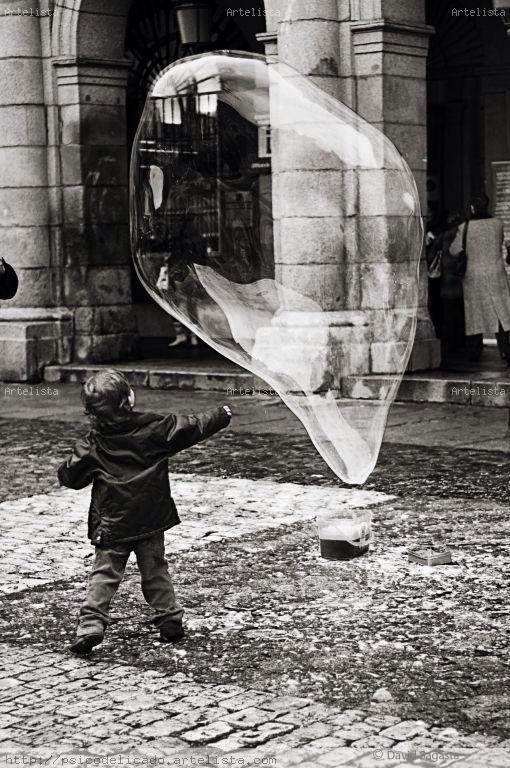
Newton is depicted as being struck by the discovery of the phenomenon of light refraction as he observes a child blowing bubbles.
In the painting the bubble becomes the world. A globe is placed on the right-hand side of Newton. The bubble occupies a similar position with the child. 

Blow bubbles so they float down into the clear container. The bubbles will descend and then hover on the denser layer of carbon dioxide gas accumulating above the dry ice.

After a few minutes, notice that the bubbles begin to expand and sink. Notice how some of the bubbles freeze on the dry ice.

Frank Oppenheimer was an experimental physicist. And one of the crucial instruments of his era for visualizing the paths of subatomic particles was the BUBBLE CHAMBER.

Invented by Nobel Laureate Physicist Donald Glaser. This device used a superheated transparent liquid like liquid hydrogen that would boil and form a trail of tiny bubbles along the path of a charged particle passing through it.

These tracks could then be photographed and analyzed to understand the fundamental building blocks of matter.

https://www.newyorker.com/magazine/1960/11/19/bubbles-2

Adults need their own time to experiment with materials like Bubbles.
By experimenting you might realize that what you are really doing is exploring concepts like surface tension, balance, aerodynamics and velocity. Nature is a significant source of materials. And nature is the language of Mathematics.

David Hawkins Mathematician & Philosopher Of Science

Bubble Play studies forces like thickness, wind speed, flow, elasticity, film drainage & bursting dynamics.

A single, simple bubble is actually a complex scientific model.

Soap Bubble Investigation looks into physics, chemistry and fluid dynamics.

Change a bubble solution recipe by adding glycerin, sugar or alternating blowing techniques.

How long does the bubble last?

What happens to its size?

How does the revised bubble behave?